Why Choose a Handheld Laser Welder for Your Business?
Choosing a handheld laser welder can change how a workshop handles repair and production work. The tool is portable, and its focused beam can create narrow welds with limited heat spread when the setup is appropriate. For a small fabrication shop, that may mean joining stainless-steel brackets at a bench, repairing a thin enclosure, or reaching a seam that is awkward for a larger machine. Less rework can matter. But results depend on the material, joint design, settings, and operator skill—not the equipment alone.
A sound buying decision starts with the jobs you actually perform. Compare rated power, compatible materials, duty cycle, available service, and the cost of consumables. Ask for a demonstration using parts similar to your own, and inspect the welds rather than relying on speed claims. There is a catch. Laser systems require suitable shielding, training, and a controlled work area; confirm these needs with the supplier and follow its safety guidance. Consider maintenance and staff learning time, too. A machine that sits idle is not a bargain.
This guide looks at where a handheld laser welder may fit, what to check before investing, and which trade-offs deserve attention. Some shops may find that conventional welding remains the better choice. That is worth admitting. The right decision comes from measured trials, clear operating procedures, and realistic expectations about production gains.
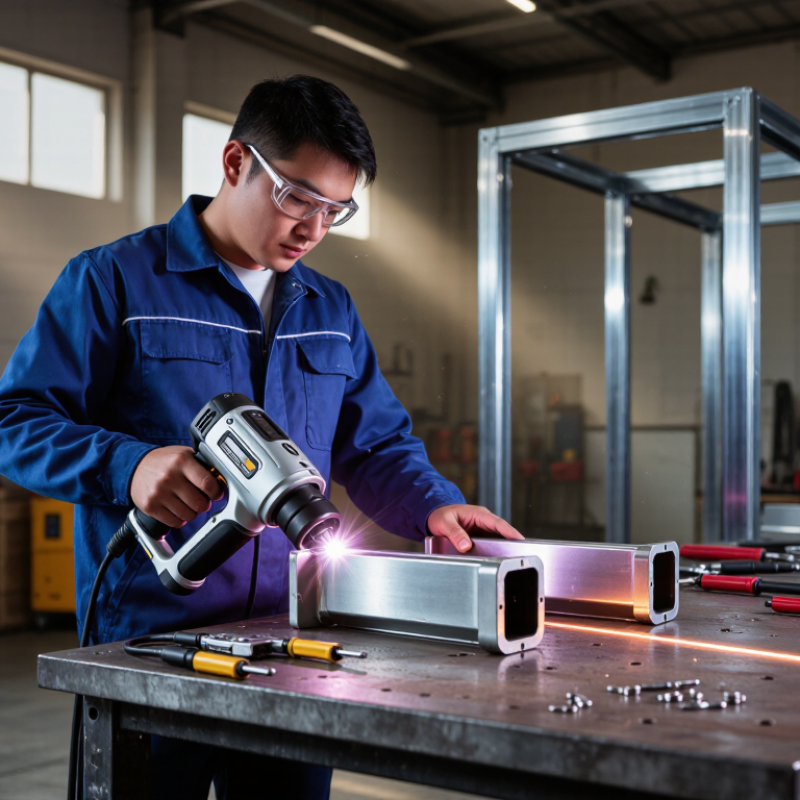
Handheld Laser Welder Basics: Fiber Lasers Commonly Operate Near 1,070 nm
Handheld fiber laser welders commonly operate near 1,070 nm, in the near-infrared range. The wavelength is invisible to the eye. Its energy is concentrated into a small spot, heating metal locally while limiting the size of the heat-affected area. Results still depend on material, surface condition, focus, and travel speed.
Wavelength also helps explain the process. Using the speed of light and Planck constant in NIST’s 2022 CODATA recommended values, 1,070 nm corresponds to about 280 terahertz and 1.16 electronvolts per photon. These figures describe the light, not weld quality. In practice, reflective surfaces and poor joint fit can still cause inconsistent results. A quick test on matching scrap is worth the extra minutes.
Tips: Keep the nozzle steady and the workpiece clean. Check focus before production runs. Never assume the same settings will suit every metal thickness. A small bead can look neat, yet still lack penetration.
Why Choose a Handheld Laser Welder? Wavelength Basics
Fiber lasers commonly used in handheld welding operate near 1,070 nm (1.07 μm). The chart compares representative wavelengths of several laser types; diode laser wavelengths vary by source.
Key point: Fiber and Nd:YAG lasers have similar wavelengths, while CO₂ lasers operate at a much longer wavelength. Wavelength is one factor in choosing a welding system; material, joint design, and process requirements also matter.
Power and Capacity: Compare Common 1–3 kW Models with Material Thickness
Why Choose a Handheld Laser Welder for Your Business?
Power and Capacity: Compare Common 1–3 kW Models with Material Thickness
For many shops, a handheld laser welder offers fast travel speeds and a compact working setup. Power helps determine how much material a unit can fuse, but wattage alone does not set the limit. As a rough guide for mild steel, a 1 kW model often suits sheets around 1–2 mm thick. A 2 kW model may handle roughly 2–4 mm, while 3 kW systems can tackle thicker sections, sometimes around 3–6 mm. These are starting points, not guarantees. Joint design, surface condition, wire use, and operator technique all matter.
Fit-up matters. A narrow gap can produce a clean bead; a wider one may need filler or a slower pass. The tidy chart is useful, but it can mislead. Test coupons made from your actual material reveal more than a headline capacity figure. Check the machine’s stated limits and have a qualified operator verify settings before production.
Tips: Keep sample pieces in the same thickness and joint shape as your real parts. Inspect both sides of each weld, and note travel speed and settings. If penetration is inconsistent, pause and review the setup rather than simply increasing power.
How Welding Works: Beam Power, Travel Speed, and Shielding Gas Shape Results
Why Choose a Handheld Laser Welder for Your Business?
A handheld laser welder gives operators flexibility on large panels, corners, and repair work. But weld quality depends on more than laser power. Beam power controls energy entering the joint; travel speed controls how long that energy stays in one spot. Too much heat can widen the bead or distort thin sheet. Too little can leave incomplete fusion. TWI’s laser-welding guidance reports speeds up to 10 m/min in suitable applications. That figure describes process capability, not a guaranteed handheld production rate.
Shielding gas protects the hot weld pool from air and helps manage surface oxidation. The right gas and flow depend on the material, joint, nozzle position, and surrounding airflow. A draft near the bench can disrupt coverage. More gas is not always better; excessive flow may create turbulence. Small changes matter. Operators should test settings on matching scrap, then inspect bead shape, penetration, and discoloration. A clean-looking seam can still hide weak fusion.
Tips: Change one setting at a time. Keep the nozzle angle and stand-off consistent, and record power, speed, and gas flow with each trial. Check the finished joint against the application’s acceptance criteria. A tidy bead is useful, but it is not proof of strength.
Business Fit: Compare Cycle Time, Labor Hours, and Cost per Weld
A handheld laser welder may shorten weld time, but the useful comparison is cost per acceptable weld. Track a representative batch, such as stainless brackets with the same thickness and joint design. Record arc-on time, loading, fit-up, cleaning, and finishing separately. A fast bead does not guarantee a faster finished part.
Labor hours can fall when fewer passes or less post-weld grinding are needed. But setup, operator training, and inspection still take time. The gap is real. Compare the same parts and quality criteria, and include rework rather than counting only successful first passes. One shop’s results may not transfer neatly to another.
For cost per weld, divide total production cost by the number of accepted welds. Include labor, equipment depreciation, shielding gas, consumables, maintenance, and rework. Then compare that figure with your current process over enough parts to smooth out unusual jobs. Measure it. Estimates can be misleading, especially when joint fit-up varies or operators are still learning. A small trial with documented cycle times and labor minutes gives a more grounded basis for deciding whether the equipment fits your workflow.
Why Choose a Handheld Laser Welder for Your Business? - Business Fit: Compare Cycle Time, Labor Hours, and Cost per Weld
| Business Metric |
Handheld Laser Welding |
MIG Welding |
TIG Welding |
| Example application |
Repeatable, accessible 1 m mild-steel seam |
Repeatable, accessible 1 m mild-steel seam |
Repeatable, accessible 1 m mild-steel seam |
| Estimated cycle time per seam |
45 seconds |
120 seconds |
180 seconds |
| Direct labor for 100 seams |
1.25 hours |
3.33 hours |
5.00 hours |
| Estimated labor cost per seam |
$0.38 |
$1.00 |
$1.50 |
| Estimated consumables and process energy per seam |
$0.35 |
$0.55 |
$0.45 |
| Estimated operating cost per seam |
$0.73 |
$1.55 |
$1.95 |
| Estimated operating cost for 100 seams |
$72.50 |
$155.00 |
$195.00 |
| Potential business advantage |
Shorter cycle time can reduce direct labor on suitable repeat work. |
Versatile process with established workflows and broad applications. |
Useful where precise heat control and weld appearance are priorities. |
Illustrative estimate, not a guaranteed production result. Cycle times represent a simple, repeatable 1 m seam and include basic positioning and handling; actual results depend on material, thickness, joint fit-up, access, operator, and required quality.
Cost estimates use a loaded labor rate of $30 per hour. Consumables and process energy are estimated per seam. Equipment purchase or lease, depreciation, setup, fixturing, inspection, rework, training, and safety-system costs are excluded; include these costs when evaluating a specific business case.
Safety Requirements: IEC 60825-1 Class 4 Laser Controls
A handheld laser welder brings the beam close to the operator and nearby workers.
Under IEC 60825-1, Class 4 indicates a high-hazard laser category: direct and reflected beams can injure eyes or skin and may ignite materials. The handpiece is portable, but the beam hazard does not stay confined to the workpiece.
Set up a controlled work area before welding.
Use suitable laser-rated barriers or curtains, restrict access, and place clear warning signs at entry points. Interlocks, key control, and warning lights can help prevent unintended operation or entry. Select protective eyewear for the laser’s wavelength and output; ordinary workshop glasses are not enough. Verify the rating and fit.
Keep a beam stop behind the joint,
and remove reflective scrap, oily rags, and other combustible material from the work zone. Train operators to inspect the setup, secure the workpiece, and stop if the beam path is uncertain. That takes time. It can feel restrictive, especially during quick repairs, but shortcuts create avoidable exposure. IEC 60825-1 addresses laser product classification and safety; workplace controls should also follow applicable local requirements and a site-specific risk assessment. No checklist replaces a careful review of the actual equipment and workspace.