How to Choose the Best Fiber Laser Marking Machine?
Choosing the best fiber laser marking machine is rarely about selecting the highest wattage. It is about matching the machine to your materials, production rhythm, marking depth, and quality expectations. Stainless steel may need crisp annealing, while aluminum often requires controlled contrast and heat management. Plastics can be less predictable. Some absorb the wavelength well; others melt, discolor, or produce weak marks.
Valentin Gapontsev, founder of IPG Photonics and a major figure in fiber-laser technology, is often associated with this practical principle: “We do not sell lasers; we sell solutions.” That idea matters when comparing a fiber laser marking machine. A reliable system should combine stable power, suitable pulse settings, accurate scanning, and software that operators can learn quickly. Look beyond speed claims. Ask for sample marks on your actual parts. Check edge sharpness under magnification. Measure cycle time, not just advertised marking speed.
A good machine also fits the workplace. Consider enclosure design, fume extraction, lens options, maintenance access, and operator safety. Technical support matters more than many buyers expect. Downtime can erase the savings from a cheaper purchase.
Still, no machine is perfect. A powerful source may be unnecessary for shallow identification marks. A compact unit may struggle with large-format work. My own caution is simple: specifications can look impressive while the final mark disappoints. The best choice comes from testing, documentation, and honest comparison. This guide explains the key factors, helping you choose performance that remains dependable after installation.
Define Your Marking Requirements and Production Goals
Before choosing a fiber laser marking machine, define the job in measurable terms.
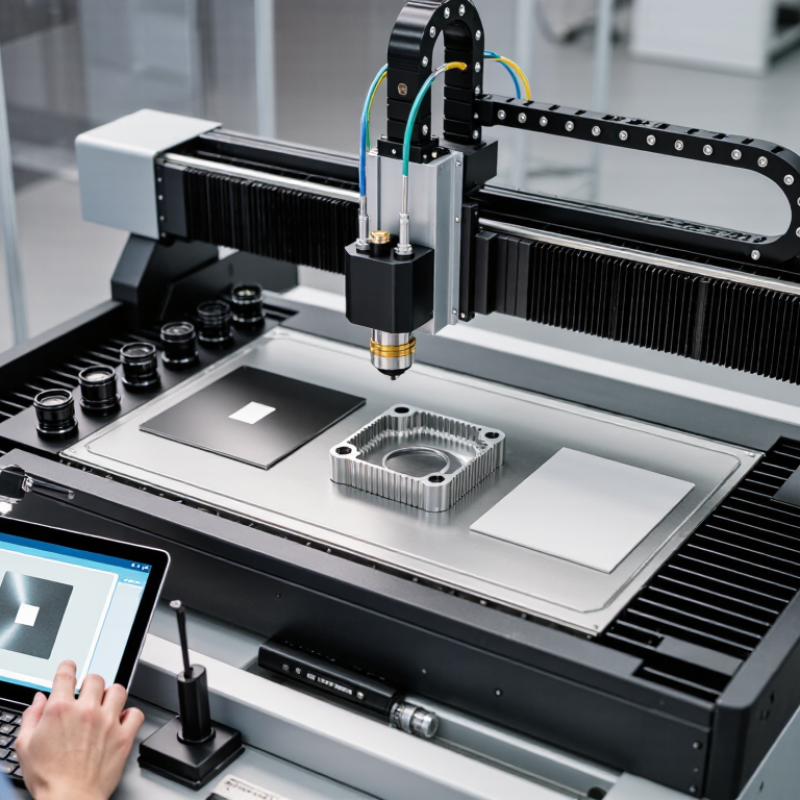
Identify the material, surface finish, marking area, character height, contrast, and required depth. Stainless steel may need a dark annealed mark, while aluminum often requires clean, shallow contrast. Test samples from actual production batches. Small differences in coatings can change results.
Production targets matter equally.
Record parts per hour, shift length, loading method, and acceptable rejection rates. The 2024 MarketsandMarkets Fiber Laser Market report estimates the sector will grow from about USD 4.9 billion in 2023 to USD 8.1 billion by 2028. This expansion reflects wider industrial adoption, but market growth does not guarantee a suitable machine. A high-power source may be wasteful for small labels. It can also increase heat effects on sensitive parts.
Measure the complete cycle, not only laser-on time.
Include positioning, fixture changes, verification, and operator handling. Industry testing experience shows that poor fixturing often limits throughput more than laser power. Consider traceability software, barcode reading, enclosure requirements, and maintenance access. The Fortune Business Insights 2024 report places the laser marking machine market at roughly USD 3.25 billion in 2023, with continued growth expected through 2032. Report estimates vary. Your own sample trials remain more reliable than a brochure. Document failed tests too; they often reveal the real production limit.
Compare Fiber Laser Types, Power Levels, and Wavelengths
How to Choose the Best Fiber Laser Marking Machine?
Choosing a fiber laser starts with the material, not the machine’s advertised power. A single-mode source usually creates a finer, brighter spot for serial numbers and small graphics. Multimode output can deliver stronger processing on larger marks, but edges may look less crisp. Q-switched systems suit common metal marking, while MOPA systems offer better pulse control for dark anodized aluminum and heat-sensitive surfaces.
Power changes both speed and depth. A 20 to 30 watt source often handles identification marks on stainless steel, aluminum, and coated parts. Higher power can engrave deeper or reduce cycle time. However, excessive power may discolor edges, distort thin sheets, or remove too much coating. Run a small test grid first. Use identical focus, speed, and hatch settings.
Wavelength also affects absorption and heat. The standard near-infrared wavelength, around 1064 nanometers, works well across many metals. Shorter wavelengths can improve contrast on plastics, glass, or delicate finishes, but they usually require more specialized optics and cost more. Check the actual spot size, pulse width, cooling method, and software control. A compact workbench may favor lower power and air cooling. A production line needs stable calibration and repeatable focus. I would not choose from wattage alone. A perfect sample can hide poor consistency. Measure ten consecutive marks before deciding.
Evaluate Marking Quality, Speed, and Material Compatibility
How to Choose the Best Fiber Laser Marking Machine?
Evaluate marking quality, speed, and material compatibility before comparing machine prices. A sharp mark should keep clean edges under magnification. Test small text, serial numbers, and simple graphics on your actual parts. Stainless steel may need different power and frequency settings than aluminum. Excessive energy can create dark halos or distort fine details. I have found that a slower pass often produces better contrast, but production demands may require compromise.
Tips: Request sample tests using your materials. Check marks at normal viewing distance and under a work light. Measure cycle time, including loading and repositioning. Ask for repeatability data, not only the fastest demonstration. Keep test samples for later comparison.
Speed is meaningful only when quality remains stable. A machine that marks quickly but requires frequent adjustments may reduce real output. Check whether the marking field fits your largest component without extra repositioning. For curved surfaces, confirm suitable fixtures or rotary support. Consider coated metals, plastics, and anodized surfaces separately, because each may react differently. Reliable evaluation also includes software control, maintenance access, and operator training. One overlooked detail is ventilation for process fumes; the setup should follow local workplace requirements. Test several parameter sets, and record the results honestly. Some marks may look acceptable at first, yet fade after handling or cleaning.
How to Choose the Best Fiber Laser Marking Machine?
Evaluate marking quality, speed, and material compatibility
The chart compares typical fiber-laser marking performance across commonly processed materials.
Marking speed is shown as a representative operating value in mm/s, while quality and compatibility
use a 1–10 evaluation scale. Actual results vary with laser power, wavelength, pulse settings,
focal lens, surface finish, and material composition.