


What Is a Floating Pump Aerator?
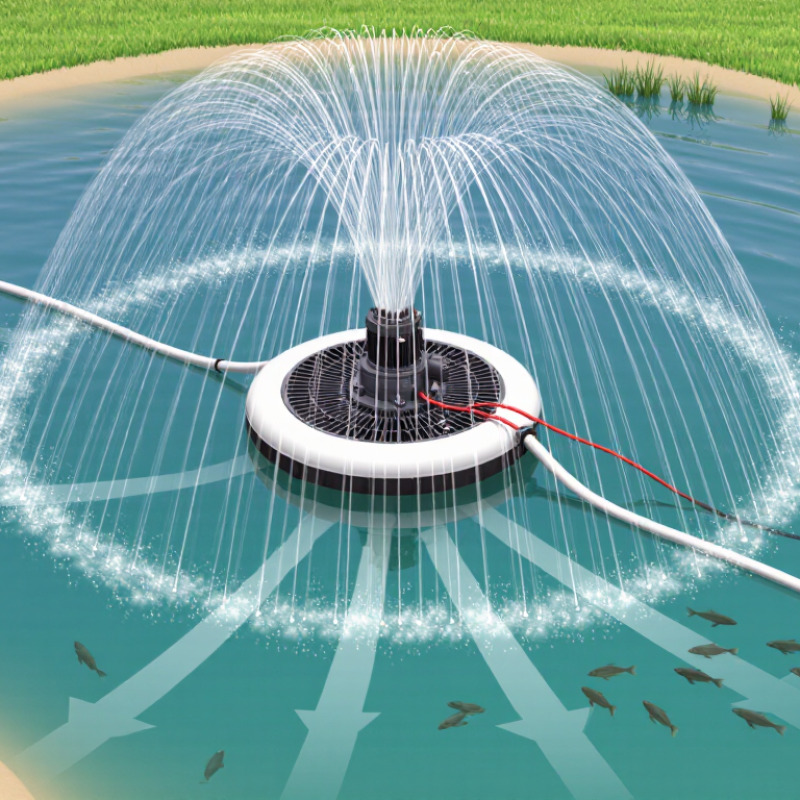
A Floating Pump Aerator is a water-treatment device that moves and oxygenates water from a floating platform. Its pump draws pond water upward, then releases it through a spray, fountain, or surface outlet. This action increases contact between water and air. It can also create visible circulation across the pond.
In practical pond maintenance, the difference is easy to notice. Ripples spread across the surface. Stagnant corners may receive more movement. Fish often gather near better-oxygenated areas, especially during warm weather. However, appearance alone does not prove that oxygen levels are safe. A dissolved oxygen meter gives more dependable information.
The system usually includes a float, pump, intake screen, motor, power cable, and discharge assembly. Proper sizing depends on pond depth, surface area, fish population, water temperature, and organic loading. A small unit may support a decorative pond, while a larger model may serve aquaculture or wastewater applications. It is not a universal cure.
Poor placement can leave deeper water untreated. Clogged screens can reduce flow and strain the motor. Electrical connections also require careful installation near water. Regular inspection matters.
Some claims about aerators sound overly confident. One unit cannot solve every algae, odor, or circulation problem. A responsible evaluation considers water testing, maintenance access, energy use, and seasonal conditions. This article explains how a Floating Pump Aerator works, where it performs well, and what limitations buyers should examine before installation.
What Is a Floating Pump Aerator?
A floating pump aerator is a buoyant water-treatment unit that moves and oxygenates surface water. Its pump draws water through an intake, then releases it as a jet, spray, or turbulent stream. This contact exposes more water to atmospheric oxygen. The unit also circulates deeper, oxygen-poor layers toward the surface.
The core function is dissolved-oxygen transfer. The U.S. Environmental Protection Agency’s Nutrient Control Design Manual reports that aeration can consume about 45–75% of energy in activated-sludge treatment. That figure shows why oxygen delivery needs careful control. In ponds, reservoirs, and aquaculture systems, operators often monitor oxygen near dawn, when nighttime respiration can produce the lowest readings. The U.S. EPA identifies roughly 5 mg/L as a useful freshwater benchmark for supporting many aquatic organisms, although actual criteria vary by species and temperature.
It is not merely a fountain.
A floating pump aerator can reduce stagnant zones, improve mixing, and help beneficial microorganisms process organic matter. Yet performance depends on depth, temperature, loading, and wind. A unit that looks powerful may still leave bottom water poorly oxygenated. The UN World Water Development Report 2017 noted that more than 80% of wastewater globally was discharged without adequate treatment, highlighting the wider need for reliable water management. Field checks remain essential. Visual turbulence is not proof of sufficient oxygen.
| Data Dimension | Description | Core Facts and Practical Notes |
|---|---|---|
| Definition | A floating pump aerator is a water-treatment device mounted on a buoyant platform that pumps and disperses water at or near the surface. | It combines water circulation with aeration and operates without a permanent fixed structure in the water body. |
| Primary Function | To increase the transfer of atmospheric oxygen into water while improving circulation. | Higher dissolved oxygen can support aerobic biological activity and help reduce oxygen-depleted conditions. |
| Operating Principle | An electric motor drives an impeller or pump that draws in water and projects it through the surface. | Water droplets, splashes, and turbulence increase the water-to-air contact area, improving oxygen transfer. |
| Main Components | Floating platform, pump or impeller, electric motor, intake screen, discharge assembly, power cable, and anchoring system. | The intake screen helps limit the entry of large debris, while anchors or mooring lines keep the unit within its operating area. |
| Installation Position | Installed on the water surface and connected to shore-based electrical equipment or an approved floating power supply. | The unit should be positioned to promote circulation and kept clear of intake restrictions, heavy boat traffic, and unsafe electrical conditions. |
| Typical Applications | Ponds, aquaculture facilities, wastewater lagoons, stormwater basins, reservoirs, and decorative lakes. | The appropriate design depends on water depth, organic loading, required circulation, operating hours, and local environmental conditions. |
| Aeration Mechanism | Surface aeration is produced by splashing, spraying, or rapidly agitating water. | Performance is influenced by droplet size, turbulence, water temperature, dissolved oxygen deficit, and the residence time of water in contact with air. |
| Water-Circulation Effect | The discharge pattern moves water horizontally and vertically around the floating unit. | Circulation can help distribute oxygen and reduce localized stagnant zones, although complete-body mixing is not guaranteed. |
| Common Performance Measures | Dissolved oxygen concentration, oxygen transfer rate, standard oxygen transfer efficiency, water flow rate, and electrical power consumption. | Performance ratings should be compared under equivalent test conditions because temperature, water quality, salinity, and test depth affect results. |
| Advantages | Flexible placement, relatively simple installation, visible operation, and effective surface mixing. | Floating installation can be useful where permanent foundations are impractical or where seasonal relocation is required. |
| Limitations | Surface aeration may provide less direct oxygen delivery to deep water than submerged diffused-air systems. | Wind, waves, ice, algae, debris, electrical access, and insufficient mixing depth can reduce operating effectiveness. |
| Energy Requirement | Electricity is required to operate the motor and pump. | Actual energy use varies with motor size, pump head, flow rate, duty cycle, and site-specific water resistance. |
| Maintenance Needs | Routine inspection of the intake screen, impeller, motor, floats, cable, fasteners, and anchoring system. | Remove accumulated weeds and debris, check for abnormal vibration or noise, and follow electrical safety procedures before servicing. |
Note: Actual capacity, oxygen-transfer performance, power consumption, and coverage area vary by equipment design and site conditions.


