
hero image

Top Touch Switch Manufacturers for Global Buyers

Global buyers evaluating Touch Switch manufacturers need more than polished catalogs. They need dependable performance, clear documentation, and products suited to real installation conditions. A switch may look elegant on a showroom wall. Yet moisture, repeated contact, wiring constraints, or inconsistent touch response can change the experience completely. Small details matter.

Design expert Don Norman offers a useful reminder: “A brilliant solution to the wrong problem can be worse than no solution at all.” His observation applies to sourcing, too. The best supplier is not automatically the one with the widest range or lowest quoted price. Buyers should compare operating voltage, panel materials, response behavior, production capacity, quality controls, and after-sales support. Ask for test reports and sample units. Check whether the manufacturer can explain its specifications plainly. That clarity is a good sign.

There are trade-offs. A feature-rich Touch Switch may not suit every project, and a sample cannot reveal every production issue. That is worth remembering. This guide introduces manufacturers serving global buyers and outlines practical points for comparing them. It considers product range, customization, quality evidence, communication, and delivery capability. No ranking can replace project-specific checks. Still, careful questions can expose gaps early—before a small component becomes a costly installation problem.
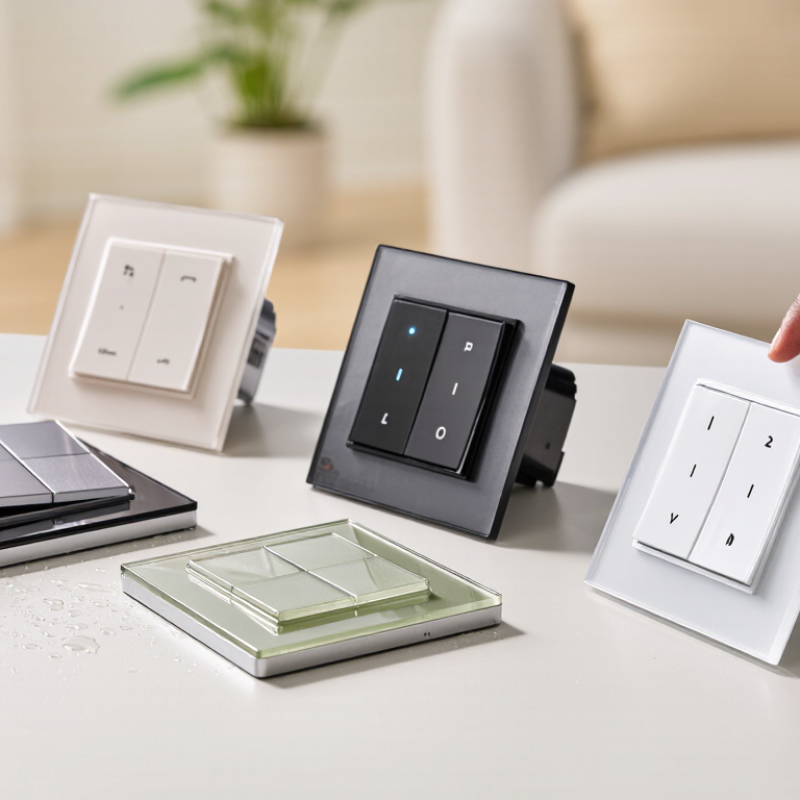
Top Touch Switch Manufacturers for Global Buyers

What Is a Touch Switch and How Does It Work?

What Is a Touch Switch and How Does It Work?

A touch switch controls a circuit when a person touches its sensing surface. Unlike a mechanical switch, it usually has no moving parts beneath the panel. Many models detect a change in capacitance. Your finger conducts a small electrical charge, changing the sensor’s field. The controller reads that change and turns the connected load on or off. It feels simple. The electronics are not.

A typical unit contains a touch-sensitive electrode, a control circuit, and a switching component, such as a relay or semiconductor. The electrode may sit behind glass, plastic, or another nonconductive surface. A short touch can trigger a response, while some designs support dimming through a longer touch. Performance depends on the sensor design, panel thickness, grounding, and electrical noise nearby. A damp surface or thick covering can affect sensitivity. That detail is easy to overlook.

Tips: Check the rated voltage and load before installation. Test the switch with the actual panel material, not just on a workbench. If it responds inconsistently, inspect grounding and nearby power cables. Touch controls can be convenient, but they are not automatically more reliable in every setting. I would still want a clear manual override where uninterrupted operation matters.

Which Types of Touch Switches Serve Global Markets?

Global buyers mainly choose among capacitive, resistive, infrared, and piezoelectric touch switches. Capacitive models detect changes in an electric field. They suit smooth glass panels, bedside controls, and sealed appliance surfaces. They respond quickly, but thick gloves or moisture can affect operation. Small detail, big consequence.

Resistive switches register pressure between layered surfaces. They can work with gloved hands and simple styluses, making them useful for industrial panels. Their overlays may wear faster under repeated pressing. Infrared switches detect interrupted light beams, so they work well on larger interfaces where users need not press a precise spot. Piezoelectric types generate a signal from applied pressure. Their solid surfaces can suit demanding public or industrial settings, though design and integration may cost more.

The Grand View Research touchscreen market report estimated global revenue at USD 87.13 billion in 2023 and projected an 8.5% compound annual growth rate from 2024 to 2030. This broad market figure does not measure touch switches alone, but it reflects expanding demand for touch-based interfaces. Buyers should test switches with actual gloves, cleaning routines, and expected finger pressure. A showroom test is not enough. Device size, control-panel material, and exposure to water can change the best choice; sometimes the specification still misses what operators need.

Top Touch Switch Manufacturers for Global Buyers - Which Types of Touch Switches Serve Global Markets?
Touch Switch Type Operating Principle Common Form Factors Typical Applications Key Considerations for Global Buyers
Capacitive Wall Switch Detects a change in capacitance when a finger approaches or touches the sensing surface. Flat glass, plastic, or ceramic wall panels; single- or multi-gang layouts. Residential lighting, hotel rooms, offices, and other indoor building controls. Check the required wall-box dimensions, wiring arrangement, load compatibility, and local electrical approvals. Some models require a neutral wire.
Capacitive Control Panel Uses one or more capacitive electrodes beneath a non-conductive overlay to register touch input. Printed control panels, appliance interfaces, sealed front panels, and touch-key arrays. Home appliances, HVAC controls, access systems, and industrial equipment interfaces. Confirm overlay material and thickness, sensitivity adjustment, cleaning requirements, and performance in the expected moisture and temperature conditions.
Piezoelectric Touch Switch Generates an electrical signal when a piezoelectric element is mechanically stressed by a press or tap. Metal or sealed push surfaces, often with no moving mechanical parts. Public-area controls, machinery, washdown environments, and applications requiring a robust front surface. Review activation force, mounting method, output interface, ingress-protection rating, and suitability for the intended duty cycle.
Resistive Touch Switch Registers input when pressure brings conductive layers into contact. Membrane keypads, flexible overlays, and pressure-operated touch panels. Equipment controls and interfaces where operation with a gloved finger or stylus may be useful. Evaluate surface wear, expected press life, required operating force, and compatibility with the controller or switching circuit.
Infrared Touch Switch Detects interruption or reflection of infrared light near the sensing area. Contactless panels, recessed sensors, and surface-mounted control modules. Hands-free controls, sanitary environments, and installations where users should not touch the control surface. Check detection distance, ambient-light performance, sensor alignment, and resistance to dust or obstruction.
Touch Dimmer Switch Combines a touch sensor with an electronic circuit that adjusts lighting output. Wall-mounted dimmers, bedside controls, and integrated lighting panels. Residential and hospitality lighting where users need on/off and brightness control. Verify compatibility with the lamp type and driver, dimming method, minimum load, wiring, and local electrical requirements.

How to Evaluate Touch Switch Manufacturers and Suppliers

Evaluating touch switch manufacturers starts with the actual installation, not a catalogue image. A switch behind 4 mm glass may respond differently from one mounted on acrylic, especially with wet fingers, gloves, or nearby electrical noise. Ask suppliers for operating-voltage ranges, compatible load types, switching-life results, and test conditions. A cycle-life figure means little without its load and test method. Request reports for electromagnetic immunity, electrostatic discharge, temperature, and humidity; IEC 61000-4-2 provides a recognized framework for ESD testing. Check whether samples behave consistently across several presses, not just one demonstration. Small detail. The touch threshold can be too sensitive.

Supplier credibility also depends on traceability and production control. Review quality-system certificates, incoming inspection records, failure-analysis procedures, and the process for notifying buyers about component changes. Grand View Research estimated the global smart-home market at USD 127.8 billion in 2023 and projected a 27.0% compound annual growth rate from 2024 to 2030. This growth signals expanding demand for connected controls, but it does not prove that any individual switch is reliable. Compare samples against written specifications, then confirm that the production unit matches. Ask how firmware or sensor settings are controlled between batches. A polished sample can hide uneven manufacturing; that is easy to overlook. Also examine lead times, spare-part availability, and the supplier’s response to a documented defect.

Which Features Matter When Comparing Touch Switch Products?

When comparing touch switch products, look beyond the glass panel. Check the rated voltage and load type, especially if the switch will control LED drivers, which can draw brief inrush currents. Confirm whether it requires a neutral wire, and test its response with dry and slightly damp fingers. A switch that looks sleek but misses a touch near the edge can frustrate users every day. It happens.

Durability matters. Ask for documented switching-cycle tests, surface scratch resistance, and operating-temperature limits. For kitchens or entryways, review the stated ingress protection rating rather than relying on appearance. Also verify compatibility with the intended wall box, wiring, and dimmable lamps. The International Energy Agency’s 2019 Global Status Report for Buildings and Construction attributed 36% of global final energy use to buildings; efficient controls can support better energy management, but only when paired with suitable loads and settings. For market context, Grand View Research estimated the global smart-home market at $127.8 billion in 2023. That growth makes interoperability worth checking: look for clear protocol support, reliable manual operation, and useful instructions if connectivity fails. I would still ask suppliers for test reports, not just feature lists. A polished specification sheet is not proof of consistent performance.

How to Choose a Manufacturer for Your Application

Choosing a touch switch manufacturer starts with the application, not the catalogue. A kitchen backsplash needs a sealed, easy-to-clean surface; a bedside panel may need reliable operation with dry fingers and low-glare indicators. Ask for operating-voltage ranges, load type, switching life, ingress-protection ratings, and test conditions. A rating without its test method tells you little.

For building projects, energy and control compatibility matter too. The International Energy Agency’s Global Status Report for Buildings and Construction 2023 estimates that buildings used 34% of global energy demand in 2022. That figure makes efficient lighting control a practical consideration, not just a feature. Check whether the switch works with the intended LED drivers, dimmers, and control system. Request documented compatibility tests, rather than relying on a general “LED compatible” claim. Small details matter.

Assess the manufacturer’s evidence. Review sample test reports, component traceability, quality-control procedures, and consistency across production batches. Ask how the team handles custom capacitive sensitivity, installation depth, and electrical noise from nearby equipment. These details can prevent false triggering after installation. For a high-volume order, inspect pre-production samples under realistic conditions: dusty hands, repeated taps, and the actual wall material. A polished sample is not the whole story. I would also ask for failure data over time; suppliers may not have a perfect answer, and that gap deserves a closer look.