
1101 W. Sanilac Rd. Caro, MI 48723
989.673.6690
Choosing Soundproof aluminum folding doors is not simply a matter of comparing prices or attractive product photographs. Global buyers need practical evidence, tested performance, and dependable manufacturing details. These doors must control voices, traffic noise, machinery sounds, and outdoor disturbances without sacrificing natural light or usable space.
Acoustics expert Leo Beranek defined noise simply: “Noise is unwanted sound.” That principle matters when evaluating folding door systems. Acoustic performance depends on several connected parts. These include laminated glass, insulated frames, compression seals, panel alignment, threshold design, and installation quality. A strong frame cannot compensate for a poor seal. Even a small gap beneath a panel can weaken the entire sound barrier.
The best Soundproof aluminum folding doors should provide documented sound reduction values, suitable glass specifications, and clear testing conditions. Buyers should ask whether laboratory results reflect the complete installed system. Sometimes, they do not. That distinction deserves attention.
Look closely at the hardware, too. Smooth rollers, firm locks, and durable hinges support consistent closure after thousands of cycles. Coastal projects may require enhanced corrosion resistance. Hotels may prioritize privacy. Offices may need flexible partitions and reliable daily operation.
No folding door creates absolute silence. That expectation is unrealistic. However, a well-designed system can make a room noticeably calmer, more private, and more comfortable. Product selection should combine acoustic data with climate, building use, maintenance needs, and local installation expertise. The most convincing supplier is not always the one making the loudest claim.
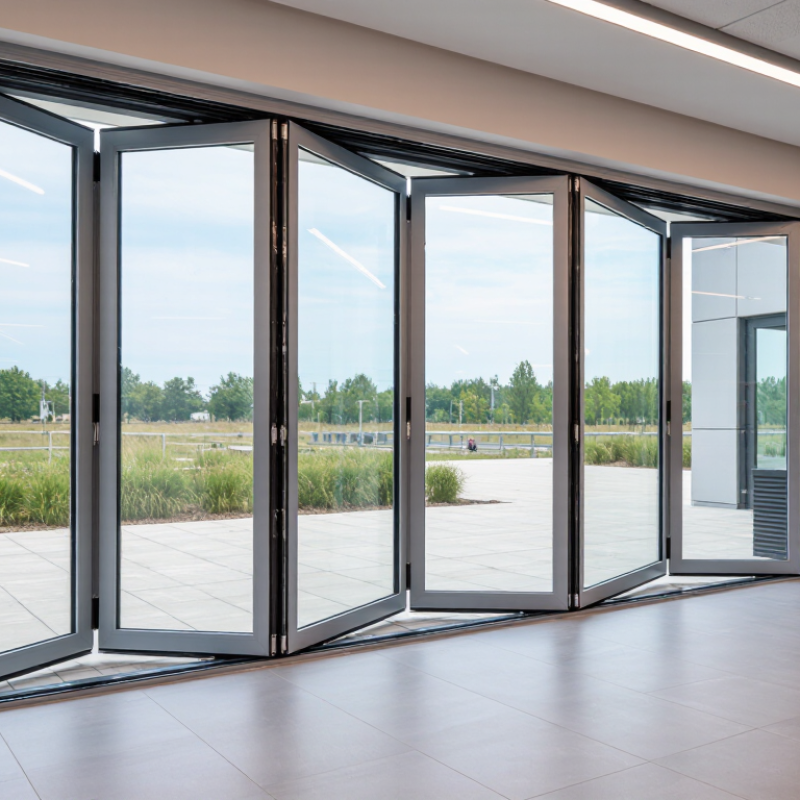
Top Soundproof Aluminum Folding Doors for Global Buyers
Soundproof aluminum folding doors are multi-panel systems designed to reduce airborne noise while opening wide. They combine aluminum frames, acoustic glass, interlocking panels, compression seals, and floor tracks. The term “soundproof” is not absolute. In practice, these doors provide sound reduction, not silence.
Performance is commonly measured through Sound Transmission Class (STC) under ASTM E90 and ASTM E413, or through ISO 10140 laboratory testing. Basic glazed folding doors may achieve approximately STC 30–35, while specialized systems can reach STC 40–45 or higher. Results depend on glass thickness, panel joints, seals, and installation quality. A 2023 acoustic building-performance report from an international testing organization noted that perimeter leakage can reduce real-world results by several decibels. Small gaps matter.
The World Health Organization’s Environmental Noise Guidelines recommend keeping indoor night noise below 30 dB(A) for good sleep conditions. This target is not a door rating, but it shows why room layout and exterior noise also matter. A door facing heavy traffic needs different testing than one separating a quiet office. Buyers should request laboratory reports, tested assembly sizes, glazing details, and field-installation guidance. Higher STC is not automatically better. A heavy panel may improve isolation but increase operating resistance. The weak point is often installation. Even an excellent system can underperform when the sill is uneven or seals are compressed poorly.
Soundproof aluminum folding doors combine thermally broken aluminum frames, perimeter seals and acoustic glazing to reduce airborne noise while allowing wide openings. The chart shows representative weighted sound reduction values (Rw) for common glazing configurations used in folding-door systems. Higher values indicate better laboratory-rated sound insulation.
Actual performance depends on the complete door assembly, including frame design, seals, joints, panel size and installation quality. Rw values should be verified through laboratory testing of the finished system in accordance with applicable acoustic standards.
Top Soundproof Aluminum Folding Doors for Global Buyers
Aluminum folding doors can reduce noise, but their performance depends on the complete door system. Aluminum frames provide strength, not major sound absorption. Noise often enters through glass, meeting rails, seals, and floor gaps. Folding panels also create more joints than fixed windows. That detail is easy to underestimate.
The World Health Organization’s Environmental Noise Guidelines for the European Region (2018) recommends limiting road traffic noise below 53 dB Lden outdoors. This target shows why weak openings matter in urban buildings. Buyers should request laboratory results tested under ASTM E90, ASTM E413, or ISO 10140 procedures. Look for both STC and Rw values. Higher ratings generally indicate better airborne sound reduction, but laboratory figures may not match site performance. Installation quality decides a lot.
Tips: Select laminated acoustic glass, continuous compression seals, insulated panel edges, and a sealed bottom track. Ask for the tested size and configuration. A high rating from a single-glazed sample may not represent a large folding wall. Check the frame corners carefully; tiny daylight gaps can carry noticeable traffic noise. On-site testing is wiser for hotels, bedrooms, and offices beside busy roads. A folding door is not a magic wall. Even careful specifications can miss flanking noise through ceilings, floors, or adjacent walls.
| Door Configuration | Typical Glass Specification | Indicative Acoustic Rating | Main Noise-Reduction Mechanism | Recommended Application | Key Buying Considerations |
|---|---|---|---|---|---|
| Standard thermally broken aluminum folding door | Double insulating glass, approximately 24–28 mm overall thickness | Rw 28–34 dB Typical STC range: 27–33 | Separated glass panes, sealed air space, compression gaskets and interlocking door panels | Residential patios, garden rooms, low-to-moderate urban noise environments | Confirm gasket continuity at panel joints and the tested rating for the complete door assembly, not glass alone |
| Acoustic laminated-glass aluminum folding door | Double glazing with an acoustic laminated pane, commonly 10.8–13.5 mm laminated glass plus an insulating cavity | Rw 34–40 dB Typical STC range: 33–39 | Viscoelastic interlayer dampens glass vibration and reduces airborne sound transmission | Homes near busy roads, apartments, restaurants and mixed-use buildings | Specify the interlayer type, glass build-up, cavity width and tested frequency spectrum |
| High-performance acoustic folding door | Asymmetric triple glazing or enhanced acoustic double glazing, approximately 36–52 mm overall thickness | Rw 40–45 dB Typical STC range: 39–44 | Greater mass, asymmetric pane thicknesses, multiple seals, thermal breaks and improved panel-to-panel interfaces | Hotels, offices, conference rooms and properties exposed to heavy traffic | Verify hardware pressure, threshold design, drainage details and the laboratory test configuration |
| Folding door with acoustic solid or insulated lower panel | Acoustic glazing above with an insulated aluminum or composite lower panel | Rw 32–40 dB Performance depends strongly on the weakest panel section | Reduces sound transmission through the opaque section while maintaining glazed daylight areas | Balconies, ground-floor openings, commercial frontages and privacy-sensitive spaces | Check whether the lower panel, frame and glazing are included in the same acoustic test |
| Low-threshold or flush-threshold folding door | Double or acoustic laminated glazing with a reduced-height sill | Rw 28–36 dB Usually lower than a fully sealed raised threshold | Uses perimeter seals and drainage channels, but the reduced sill may provide less resistance to airborne sound | Accessible entrances, indoor-outdoor living areas and universal-design projects | Balance accessibility requirements with acoustic targets; request water, air and sound test data for the selected threshold |
| Multi-panel aluminum folding wall | Acoustic double or triple glazing across large connected openings | Rw 30–42 dB Depends on panel count, opening size and joint design | Continuous frame seals and correctly aligned interlocks limit leakage paths between folding leaves | Retail spaces, hospitality venues, schools and large residential openings | More panels create more joints; inspect corner posts, meeting stiles and stacking-area seals |
| Acoustically optimized folding door with enhanced seals | Acoustic laminated double glazing or triple glazing with upgraded perimeter gaskets | Rw 38–45 dB Typical STC range: 37–44 | Combines glass damping, increased mass, flexible seals, compression hardware and minimized air gaps | High-noise urban locations, premium residential projects and meeting areas | Installation quality is critical; specify tolerances, frame anchoring and sealing around the perimeter opening |
| Typical noise-control performance by design feature | Acoustic laminated glass, wider cavities, asymmetric glazing and triple glazing | Approximately 3–10 dB improvement Compared with a basic single or standard double-glazed configuration, depending on the full assembly | Increases mass, interrupts resonances and reduces vibration transfer through the glazed area | Projects requiring targeted improvement rather than maximum sound insulation | Decibels are logarithmic; a higher rating does not guarantee the same improvement at every frequency |
Top soundproof aluminum folding doors depend on material coordination, not aluminum alone. Aluminum frames resist corrosion and support wide openings. However, hollow profiles may transmit vibration without internal reinforcement. Thermal breaks also reduce heat transfer through the frame. The U.S. Department of Energy reports that windows can cause 25–30% of residential heating and cooling energy use. Therefore, frame insulation matters as much as acoustic performance.
Glass selection changes the result sharply. Standard double glazing offers moderate noise control, while laminated acoustic glass adds a flexible interlayer that absorbs vibration. Unequal glass thicknesses can reduce resonance more effectively than identical panes. Triple glazing improves thermal insulation, but it is not automatically quieter. Buyers should request laboratory results tested under ISO 10140 or ASTM E90 procedures. The WHO Environmental Noise Guidelines for the European Region recommend limiting road traffic exposure below 53 dB Lden and 45 dB Lnight. These figures help define a practical indoor target.
Door configuration creates another weak point. A four-panel folding system may provide a wide clear opening, but every meeting stile adds a sealing line. Top-hung panels can reduce threshold friction and improve accessibility. Bottom-rolling systems may carry heavier glass, yet dirty tracks can affect alignment. Use continuous EPDM gaskets, compression locks, and a properly drained sill. Small gaps matter. A 40-millimeter acoustic glass unit cannot compensate for poor installation. Field inspection often reveals this uncomfortable truth: the frame looks premium, but the seals are uneven.
Choosing top soundproof aluminum folding doors starts with building use, not appearance. A hotel bedroom needs quiet sleep. A restaurant needs conversation control. A school needs speech clarity. The WHO Environmental Noise Guidelines for the European Region (2018) recommend indoor bedrooms stay below 30 dB(A) at night and classrooms below 35 dB(A). These figures are targets, not door ratings. A folding system must control seals, frame joints, glazing, and floor tracks. One weak gap can spoil a strong panel. In real projects, installation errors are common, and specifications can become less convincing there.
For global buying, request laboratory evidence under ISO 10140 and ratings under ISO 717-1. Ask for airborne sound insulation in Rw, or STC where local codes use it. They are not interchangeable. A higher number helps only when tested with the selected glass, seals, and panel configuration. For offices, compare open-plan background noise with privacy needs. For music rooms, low-frequency performance matters more. Aluminum is durable and slim, yet its frame can transmit vibration when thermal breaks and gaskets are poorly designed.
Tips: Match the test specimen to the real opening size. Require field testing after installation, preferably to ISO 16283-1. Leave tolerance around uneven walls. Review maintenance access for gaskets and rollers. A beautiful door with compressed seals may fail after months. Do not chase the highest rating blindly; daylight, ventilation, fire strategy, and opening frequency may matter more.
Global buyers should evaluate soundproof aluminum folding doors through tested performance, not marketing labels. ISO 10140 measures airborne sound insulation in laboratories, while ASTM E90 provides a comparable transmission-loss method. These tests produce Rw or STC ratings, but field performance is usually lower. Gaps, tracks, and poor wall connections remain common weak points.
Installation decides much of the result. The opening should be square, level, and structurally supported before fitting begins. Use continuous acoustic seals around the frame, compression gaskets between panels, and carefully aligned rollers. A 3 mm gap can become an audible path for traffic noise.
EN 14351-1 addresses external pedestrian doors, while EN 12207, EN 12208, and EN 12210 cover air, water, and wind performance. These standards help buyers compare products across markets.
Maintenance is practical, not glamorous. Clean bottom tracks monthly, remove grit, and inspect seals every six months. Replace flattened gaskets before they become brittle. WHO’s Environmental Noise Guidelines for the European Region recommends indoor nighttime levels below 30 dB(A) in bedrooms. That target is difficult with folding systems and open-plan construction.
I have seen excellent laboratory ratings weakened by uneven floors and careless seal installation. The specification should state laboratory values, expected field results, testing standards, and local climate requirements. Some projects still overestimate acoustic performance.
A quieter door is possible, but only when the entire opening is treated as one system.