
1101 W. Sanilac Rd. Caro, MI 48723
989.673.6690
A Date Bar Extrusion Line is more than a machine that pushes dough through a die. It shapes product weight, texture, and consistency at production speed. For manufacturers, the right line must handle sticky fruit mixtures, seeds, and changing recipes without frequent stoppages. Small details matter: hopper design, roller pressure, cutting accuracy, and how quickly operators can clean contact surfaces.
This overview compares ten manufacturers worldwide, focusing on practical factors such as line configuration, throughput options, automation, service support, and the ability to customize equipment. No single supplier suits every factory. A compact bakery may value a smaller footprint, while a high-volume plant may prioritize continuous feeding and dependable portion control. Buyers should verify published capacities against their own recipes and operating conditions. Numbers on a brochure can be optimistic.
For a clearly illustrative viewpoint, food-processing equipment specialist Jordan Lee puts the principle this way: “A good extrusion line protects the recipe while making every bar repeatable.” This is an editorially created quote, not a verified statement from a real interview. The distinction matters. Equipment decisions deserve evidence, not polished claims alone. Look closely at product trials, cleaning access, changeover time, and the support available after installation. These details can reveal more than a headline speed rating. The manufacturers below offer different approaches, and their strengths should be judged against a buyer’s actual product and production goals.
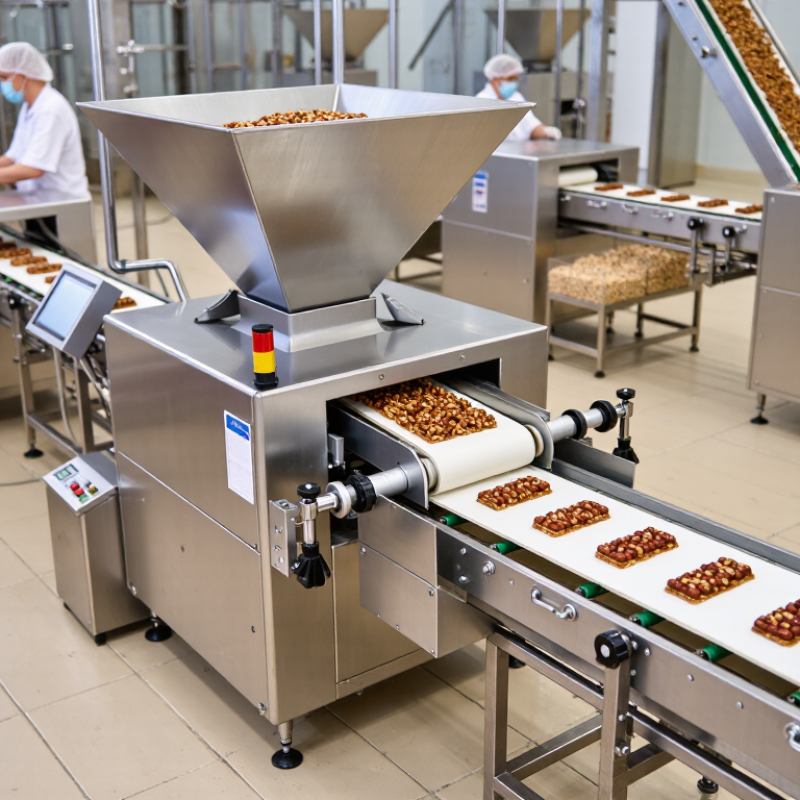
A date bar extrusion line turns a prepared fruit-and-grain mixture into continuous, evenly shaped ropes. A mixer or feed system delivers the mixture to a hopper. Inside the machine, a screw or forming rollers push the sticky mass toward a shaped die. The die controls the bar’s width and thickness, while a cutter divides the rope into consistent lengths. Simple in concept.
Date mixtures can vary in moisture, fiber, and temperature, so the same settings may not work for every batch. Operators watch the feed rate and check whether the extruded rope holds its shape. If the mixture is too dry, it may crack at the die. If it is too soft, bars can flatten after cutting. Small adjustments matter.
After cutting, bars may pass through cooling or settling equipment before wrapping. This helps them firm up and makes handling easier. A clean, accessible machine also helps crews remove sticky residue between runs. In practice, a line can produce tidy bars yet still waste material during startup. That part is easy to overlook. The cutter’s timing, die choice, and steady feeding all affect the finished bar’s appearance and weight.
When comparing date bar extrusion line manufacturers, assess how each system handles sticky paste, chopped nuts, seeds, and other inclusions. Grand View Research valued the global snack bar market at $20.41 billion in 2023 and projected 6.7% annual growth through 2030. This is market context, not proof that any particular machine performs well. Ask for proof.
Request a factory trial using your own recipe. Observe whether the feeder delivers date paste evenly, the die holds bar dimensions, and the cutter produces clean edges without dragging inclusions. Record output rate, weight variation, changeover time, and material left in the machine. A polished demonstration may not match a long production shift. That gap matters.
Compare contact-surface materials, access for cleaning, guarding, controls, spare-parts availability, and remote support. Ask for written performance data at your target recipe and throughput, plus references from comparable food operations. Check whether quoted capacity includes mixing, cooling, and downstream packaging, or only extrusion. Small details count. A machine that runs quickly but needs frequent manual adjustment can undermine usable output. Consider total operating cost, not purchase price alone, and verify claims during acceptance testing.
A practical profile of ten date bar extrusion line manufacturers should compare capabilities, not rely on a fixed global ranking. Some suppliers focus on compact lines for small batches; others build continuous systems with automatic feeding, extrusion, cooling, and cutting. Look closely at how each design handles sticky date paste. A clean, even strand matters. So does an adjustable cutter that produces bars of consistent length. Some manufacturers emphasize custom engineering, while others offer modular equipment that can be expanded later.
The strongest profiles explain real operating details: product capacity, changeover time, cleaning access, and control-system support. Check whether the quoted output matches your recipe and bar dimensions. Ask for a trial using a similar date mixture, since fruit moisture and added ingredients can affect flow. Request drawings, service response times, and a clear list of included components. A polished brochure is not proof of performance. Comparisons also have limits when suppliers use different test products or output measures.
Tips: Ask how operators clear paste from the hopper and die. Confirm spare-part availability and training. Small details matter. And remember, a line that runs well in a demonstration may need adjustment in your facility.
Date bar extrusion lines differ in how they handle mixing, feeding, forming, cutting, and cooling. Some use a compact extruder for steady, modest output. Larger systems may connect continuous mixers with multi-lane forming and automated cutting. A higher stated capacity is not automatically better. Sticky date paste can build up around rollers or the die if temperature and feed rates are poorly matched. Small details count. Ask how the line manages product changes, stoppages, and cleaning, not just its maximum hourly output. A practical trial with your own recipe can reveal uneven bar thickness or rough edges that a specification sheet may miss.
Customization often matters more than a long list of options. A line may need adjustable die widths, interchangeable cutters, or gentle handling for bars containing nuts or seeds. Cooling length and belt speed also affect how cleanly bars separate before packaging. Controls should let operators adjust settings without making routine changes unnecessarily complex. During evaluation, compare the available capacity at your target bar size and recipe; figures based on another product may mislead. I would not assume every custom feature improves production. More adjustments can mean more setup and maintenance. Manufacturers should explain what each option changes, and provide clear cleaning instructions and support for commissioning.
Choosing a date bar extrusion line starts with the recipe, not the catalogue.
Date paste varies with fruit variety, moisture, particle size, and storage temperature. Ask shortlisted manufacturers to test your own paste and inclusions. Check bar weight, edges, and cutting quality. A smooth sample is not enough. Record throughput, changeover time, and start-up waste during a sustained trial. Food safety matters. Review cleaning access, contact surfaces, and operator tasks.
Capacity claims need context. FAO’s 2023 SDG Progress Report estimated that 13.2% of food was lost after harvest and before retail in 2021. This is not a date-bar figure, but it makes yield monitoring worth discussing. UNEP’s Food Waste Index Report 2024 estimated 1.05 billion tonnes of food waste across households, food service, and retail in 2022. Ask how line controls limit off-weight bars, trim, and rejected pieces, and whether production data can be exported. Compare installed cost, spare-part lead times, training, and service response. A lower price may hide costs. Recipes and demand change; a line that fits today may need adjustment next season.