
1101 W. Sanilac Rd. Caro, MI 48723
989.673.6690
Choosing among the top 10 Air Door manufacturers in China requires more than comparing prices or catalog photos. Buyers need to understand how each model performs in a real doorway. A busy restaurant entrance faces warm kitchen air, frequent openings, and grease. A warehouse door may need a wider, stronger air stream to limit dust and temperature exchange. These differences shape what “best” means.
For a practical framing, consider this illustrative comment from Air Door specialist Li Wei, not a verified quotation: “A good air curtain must fit the doorway’s daily rhythm.” It is a useful reminder, but only a starting point. Actual performance depends on installation height, airflow direction, noise, controls, and the building’s pressure conditions. Even a well-built unit can disappoint when the opening is unusually wide or exposed to crosswinds.
This overview examines ten Chinese manufacturers through factors buyers can check: product range, application experience, technical documentation, customization options, and after-sales support. Company claims should be compared with specifications and confirmed directly, especially when projects require unusual dimensions or continuous operation. Some details may remain hard to compare across brands. That is worth acknowledging. A shortlist is not a substitute for testing a sample, reviewing clear performance data, or discussing site conditions with an engineer. The right Air Door is the one suited to the opening, operating pattern, and expectations—not merely the lowest-priced model.
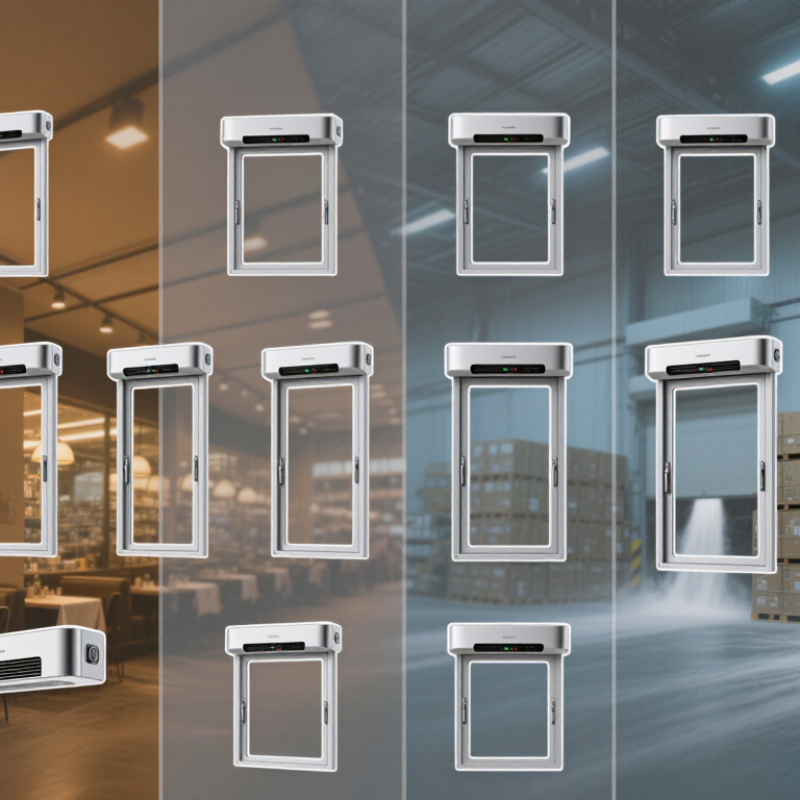
An air door, often called an air curtain, creates a moving air barrier across an open doorway. Two figures matter: airflow rate, measured in cubic metres per hour (m³/h), and outlet speed, measured in metres per second (m/s). Airflow rate describes the volume delivered over time. Outlet speed indicates how fast air leaves the slot. They are related, but they are not interchangeable.
A high m³/h rating alone does not guarantee a useful barrier. Door width, mounting height, nozzle design, and distance to the floor all affect performance. For example, a unit above a busy shop entrance must cover the full opening without leaving weak edges. Check the manufacturer’s test conditions, not just the headline number. Small details matter. Outlet speed can drop quickly as the air travels downward, and an overly strong stream may feel uncomfortable near the entrance.
Common types include unheated units, heated units, recessed models, and heavy-duty versions for larger openings. Unheated models help separate indoor and outdoor air; heated models add warmth but need suitable electrical or heating capacity. Recessed units fit into ceilings, while exposed models are simpler to inspect. There is no perfect number for every doorway. Measure the opening, consider drafts and traffic, then compare airflow and speed at the stated mounting height. A tidy specification sheet can still miss real site conditions.
A credible air-door comparison begins with repeatable testing, not a catalogue’s biggest number. AMCA 220-21 provides a laboratory method for rating air curtains’ aerodynamic performance. Key readings include discharge airflow and air-velocity distribution across the outlet. Together, these show whether the airstream is broad and consistent, or strong only at its centre. Small details matter. Test conditions and measurement positions should be stated, so buyers can compare results fairly. A high outlet speed alone does not prove that a curtain will protect a full doorway.
AMCA figures describe controlled laboratory performance; they cannot fully predict a busy entrance with cross-drafts, frequent opening, or uneven installation. That gap matters. The International Energy Agency’s 2023 Tracking Buildings report says buildings account for about 30% of global final energy consumption. It is useful context, not proof that any single air curtain will deliver savings. Ask for the AMCA 220-21 test report, including airflow and velocity data, then compare it with the door’s width, mounting height, and site conditions. I would also note where the specification is silent. Ratings help, but real entrances can be messy.
Comparing air door manufacturers in China requires more than counting product models or factory size. Buyers should assess airflow performance, motor reliability, noise, energy use, and access to replacement parts. Test reports and clear warranty terms provide stronger evidence than broad sales claims. Small details matter. Door width, ceiling height, wind pressure, and installation space can change the required configuration. One ranking cannot fit every project.
To identify ten leading suppliers, a transparent method can weigh technical capability, production consistency, customization, delivery reach, and after-sales support. Performance data should be compared under similar conditions, since airflow figures alone may hide differences in test methods. Coverage also matters: some manufacturers serve projects across China, while others focus on regional distributors or export orders. Ask where service teams operate and how quickly parts can be supplied. These answers are practical. A factory may appear strong online, yet local commissioning support can be limited. That gap deserves attention.
Market coverage should include commercial entrances, warehouses, cold-storage transitions, workshops, and other high-traffic openings. Each setting brings different demands, from frequent cycling to temperature separation and dust control. Readers should treat rankings as a starting point, not a purchase decision. Public data is uneven, and claims are not always independently verified. Honestly, that makes comparison less tidy. Request drawings, operating conditions, and references from similar installations before shortlisting suppliers.
A useful comparison of China’s air door manufacturers should begin with product range, not catalogue size. Check whether each producer offers unheated and heated units, horizontal and vertical installation, and models for narrow entrances or wide shopfronts. Note the rated air volume and door width alongside power consumption; a higher kW figure may indicate an electric heater, not a stronger airflow. Details matter.
Noise figures need careful reading. A rating in dB(A) is meaningful only when the test distance and operating speed are stated. Ask for the sound level at the intended setting, since a unit tested on low speed may sound quite different at full output. For a staffed reception area, even a small rise in noise can affect comfort. A manufacturer profile should identify the model and test conditions, rather than give one number for an entire product family.
Power should be reported in kW for the exact configuration, separating fan power from heater load where applicable. Confirm voltage, speed settings, and whether the published value is nominal or maximum. A table can still mislead if it compares a compact unheated unit with a heated model. Request the technical sheet and installation guidance before treating the figures as directly comparable. One detail is often overlooked: site conditions can change perceived noise and performance.
When comparing air door manufacturers in China, start with the entrance, not the catalogue. Measure its clear width and mounting height, then note how often the door opens and whether nearby fans create drafts. A tall loading entrance needs different coverage from a narrow shop doorway. Measure twice.
Ask suppliers to specify airflow volume and discharge velocity at your proposed mounting height. Also check that the unit spans the full opening and that its air stream can reach the floor. A motor’s rated power alone does not show how well the doorway will be protected. Numbers can mislead. If the entrance faces crosswinds or the building has pressure imbalance, ask how these conditions affect performance.
Before ordering, confirm installation clearance, access for maintenance, and expected noise. Request the supplier’s assumptions in writing, including the test conditions behind its airflow figures. Then assess the unit on site with the door cycling; check for weak spots along the floor and edges. A spreadsheet cannot replace this test. It is easy to overvalue a clean specification, and even a careful estimate can miss changing drafts or door habits. Record what needs adjustment.
Use the application ranges below to compare supplier proposals. Airflow figures are indicative calculations, not manufacturer-specific ratings.
| Entrance Type | Typical Opening Width | Mounting Height | Suggested Outlet Velocity | Indicative Airflow per Unit | Supplier Selection Check |
|---|---|---|---|---|---|
| Small shop or office doorway | 0.8–1.0 m | 2.0–2.3 m | 7–9 m/s | 1,000–1,620 m³/h | Confirm the unit covers the full opening width. |
| Standard retail entrance | 1.0–1.5 m | 2.2–2.6 m | 8–10 m/s | 1,440–2,700 m³/h | Check airflow distribution and available speed settings. |
| Restaurant or café entrance | 1.0–1.6 m | 2.2–2.8 m | 8–11 m/s | 1,440–3,168 m³/h | Ask about noise levels and cleaning access. |
| Supermarket automatic entrance | 1.5–2.0 m | 2.4–3.0 m | 9–12 m/s | 2,430–4,320 m³/h | Verify compatibility with the door sensor and opening cycle. |
| Hotel or commercial lobby | 1.5–2.4 m | 2.5–3.2 m | 9–12 m/s | 2,430–5,184 m³/h | Compare sound data, finish options, and service support. |
| Warehouse personnel doorway | 0.9–1.2 m | 2.5–3.2 m | 10–13 m/s | 1,800–2,808 m³/h | Confirm the airflow reaches the floor under site conditions. |
| Workshop or factory personnel entrance | 1.0–1.5 m | 2.8–3.5 m | 11–14 m/s | 1,980–3,780 m³/h | Check enclosure protection and operating temperature limits. |
| Large loading or service entrance | 2.0–3.0 m | 3.0–4.0 m | 12–16 m/s | 4,320–8,640 m³/h | Request a layout for multiple units or a purpose-built system. |
| Cold-storage personnel entrance | 0.9–1.5 m | 2.2–3.0 m | 9–12 m/s | 1,620–3,240 m³/h | Evaluate condensation, icing, and door-open duration. |
| High-ceiling industrial entrance | 2.0–4.0 m | 4.0–6.0 m | 14–20 m/s | 5,040–14,400 m³/h | Require project-specific airflow and mounting calculations. |
Calculation basis: indicative airflow = opening width × assumed 0.05 m outlet slot × outlet velocity × 3,600. Actual selection should use the supplier’s rated airflow and outlet-velocity data, taking account of entrance geometry, cross-drafts, indoor–outdoor temperature difference, and mounting constraints.