


A Remote Io Module can look like a small line item on a control-system drawing. In practice, it determines how reliably field signals reach the controller. Grand View Research valued the global industrial automation market at USD 205.86 billion in 2023 and projected 9.8% annual growth from 2024 to 2030. That market-wide figure is not a forecast for remote I/O alone. Still, it reflects the expanding automation environment these modules serve.
“Without data, you’re just another person with an opinion,” is a line widely attributed to quality expert W. Edwards Deming. For remote I/O selection, the point is practical: reliable data starts with the right interface. Count the required digital and analog points, then check signal types, isolation, communications protocol, and controller compatibility. Consider the cabinet, too. A module rated for the control room may struggle beside a hot motor drive or in a dusty enclosure. Check temperature and protection ratings against the actual installation.
Specifications matter. So does maintenance. Clear channel diagnostics can help a technician trace a failed sensor without guessing. Modular replacement may reduce downtime, but only if spare parts and configuration tools remain available. Here, buyers sometimes overfocus on point count. That is easy to do. This guide compares the factors that shape a sound choice, including scalability, response time, installation limits, and lifecycle support. No checklist replaces site testing; real wiring and electrical noise can expose assumptions that looked safe on paper.
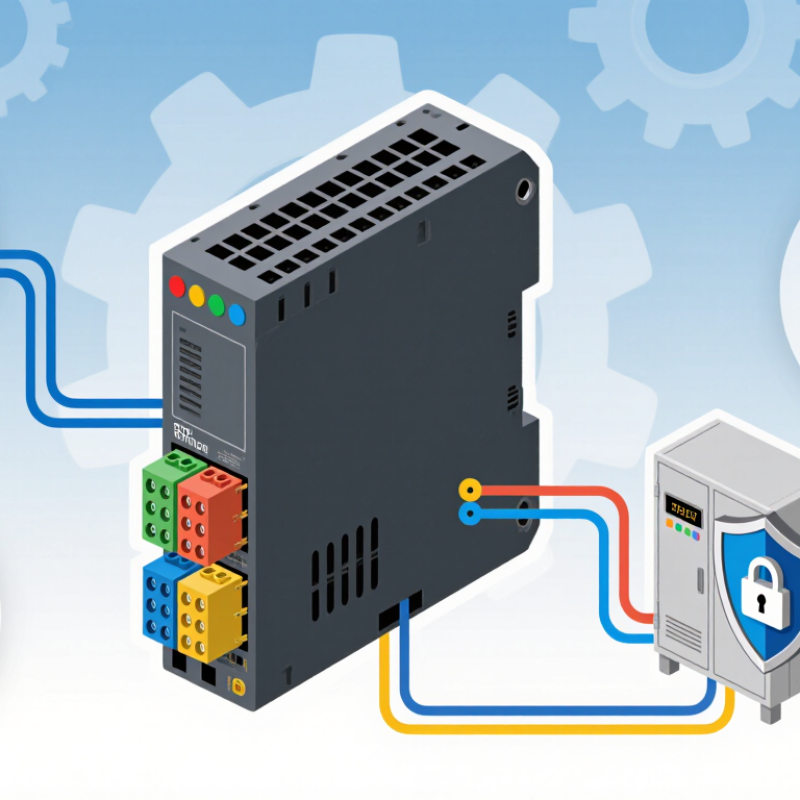
Before selecting a remote I/O module, define what the system must measure and control. Start at the signal. List each device, signal type, range, accuracy, and update rate. A temperature probe and a fast pressure switch may need different input handling. Record cable distances, ambient temperature, vibration, electrical noise, and available power at each cabinet. These details shape channel count, isolation, enclosure rating, and network requirements. Include the application’s failure response: should outputs hold their last state, or move to a safe value? Confirm this with the control engineer and equipment documentation.
Then map how data will travel, from field devices to the controller and operator station. Check protocol compatibility, network load, diagnostics, and recovery behavior after a link interruption. Deloitte’s 2024 Smart Manufacturing Survey reports that 92% of surveyed manufacturers see smart manufacturing as a key competitiveness driver over the next three years. That figure is not a remote I/O specification, but it highlights why reliable, usable plant data matters. A practical design still begins with the actual process, not a broad digitalization target. One easy-to-miss detail is future capacity: spare channels can prevent a cabinet redesign when a sensor is added. Yet adding generous spare capacity everywhere can waste space and budget. Recheck the assumptions against site conditions; a tidy spreadsheet can still miss a hot, noisy cabinet.
Use this planning table to translate application needs into practical remote I/O module requirements. Values shown as examples are common design considerations, not universal limits.
| Requirement Dimension | Questions to Define | Typical Application Considerations | Selection Guidance |
|---|---|---|---|
| Signal types and channel count | How many digital and analog signals are required now, and how many may be added later? | Digital inputs monitor on/off states; digital outputs operate devices such as solenoid valves. Analog channels commonly handle voltage or current signals, including 0–10 V and 4–20 mA. | Choose modules with the correct signal types, electrical ranges, and channel count. Allow spare channels for maintenance and planned expansion. |
| Sensor and actuator compatibility | What are the field-device supply voltage, signal wiring, polarity, and load requirements? | Common discrete devices use 24 V DC. Analog devices may use voltage or current outputs. Output modules must be rated for the connected load and switching method. | Check input thresholds, output current limits, sensor wiring configuration, and whether external field power is needed. Do not exceed module ratings. |
| Application and location | Will the I/O serve a machine, process skid, building system, or distributed field installation? | Machine control may need fast local response; process monitoring may require many analog measurements; outdoor installations may face moisture, dust, vibration, or temperature extremes. | Match the module and enclosure to the application environment. Verify the specified operating temperature range and required ingress protection for the installed assembly. |
| Network and controller compatibility | Which communication protocol, network topology, and controller interface are required? | Remote I/O communicates with a controller over an industrial network. Update rates and available diagnostics depend on the protocol, network configuration, and device implementation. | Confirm protocol compatibility, addressing method, configuration tools, topology limits, and integration with the existing controller before purchase. |
| Response time and data update | How quickly must inputs be read and outputs respond? | Slow-changing temperature or level monitoring can tolerate longer update intervals than high-speed counting, motion-related signals, or rapid interlocks. | Compare the required response time with module scan or update specifications, network cycle time, and controller task timing. Use dedicated high-speed inputs when needed. |
| Power and wiring layout | What power sources are available, and how far are field devices from the I/O location? | Remote I/O stations may require separate logic and field power. Long cable runs can introduce voltage drop, electrical noise, and grounding challenges. | Calculate current demand and voltage drop; follow the module’s grounding and shielding instructions. Consider locating I/O closer to field devices to reduce wiring runs. |
| Isolation and electrical noise | Are signals exposed to different ground potentials, switching loads, or electromagnetic interference? | Motor drives, contactors, and long cable routes can contribute to electrical noise. Isolation can help separate circuits, depending on the module design. | Check channel-to-channel and channel-to-bus isolation specifications where relevant. Use suitable cable routing, shielding, grounding, and surge protection practices. |
| Diagnostics and maintenance | Which faults must operators or technicians be able to identify? | Useful diagnostics may include channel status, wire-break detection, short-circuit indication, supply monitoring, and communication status. | Select diagnostics that support the required maintenance workflow and confirm that status information is available to the controller or monitoring system. |
| Safety requirements | Are any signals part of a personnel-safety function or required safety-rated control circuit? | Standard I/O is not automatically suitable for safety functions. Safety applications require a validated design using appropriately rated components and procedures. | Identify safety-related signals early. Use safety-rated I/O and a safety system when the risk assessment and applicable regulations require them. |
| Availability and redundancy | What happens to the process if communication or a power source is lost? | Some processes can stop safely; others may require redundant network paths, redundant power, or defined output behavior during a fault. | Define communication-loss behavior and recovery requirements. Verify that the selected system supports any required redundancy and fail-state configuration. |
| Expansion and lifecycle | How much future capacity is needed, and how will the system be maintained? | Additional sensors, actuators, or machine sections can increase channel, network, and power requirements over time. | Plan spare channels, station capacity, network bandwidth, and cabinet space. Check configuration backup, replacement, and long-term support arrangements. |
Before final selection: Verify electrical ratings, environmental limits, protocol support, certifications, and installation requirements against the module documentation and the project’s risk assessment.


