
hero image

How to Choose the Best Mud Bricks Machine?

Choosing the right Mud Bricks Machine is not simply a matter of comparing prices. It is a practical decision involving soil quality, production targets, labor skills, and long-term maintenance. A machine that performs well in one region may struggle in another. Local clay can vary in moisture, sand content, and plasticity, so testing the soil before purchase is essential. Small details matter.

An experienced buyer should examine forming pressure, brick size, cycle time, and power consumption. Ask the manufacturer for verified production data, not only attractive catalog figures. Visit a working site if possible. Watch how the machine handles uneven soil, daily cleaning, and repeated loading. Check the quality of the hydraulic system, mold design, frame structure, and replacement parts. Reliable technical support can prevent a minor fault from becoming an expensive shutdown. It is also wise to review operator training and safety features before making a final decision.

Budget remains important, but the cheapest option may create higher costs later. Weak molds can produce irregular bricks. Poor compaction can lead to cracking during drying. These problems are easy to underestimate. I have seen buyers focus on hourly output while ignoring curing space and transport time. That approach often needs reconsideration. The best choice balances performance, durability, local conditions, and realistic production goals. This guide explains the main factors clearly, helping readers compare machines with practical evidence and greater confidence.
How to Choose the Best Mud Bricks Machine?

Define Your Mud Brick Production Requirements

Before comparing mud brick machines, define what your production site actually needs. Estimate daily output from confirmed orders, not an ambitious best-case number. A small workshop making a few hundred bricks per day may need a very different setup from a facility supplying multiple building crews. Check the available floor space, power supply, water access, and room for drying racks. Measure the site. Mud also varies: clay content, sand, and moisture can change how easily a mix compacts and releases from a mold.

Decide which brick dimensions and shapes you will make, then ask how quickly the machine can switch molds. Consider who will operate it and how much training they have. A machine that meets a high output rating may still be a poor fit if feeding, cleaning, or mold changes slow the daily workflow. Ask suppliers for test results using soil similar to yours, and clarify whether stated capacity assumes uninterrupted operation. Real work includes pauses.

Plan for the whole production cycle, not just pressing. Fresh bricks need space and suitable conditions to dry, while finished units require safe handling and storage. Think about routine maintenance, replacement parts, and the skills available locally. I would leave some capacity unused on paper; actual soil and weather can be less cooperative than expected. A simple production log during trials can reveal bottlenecks before you commit to a larger setup.

Compare Machine Types, Capacities, and Forming Methods

How to Choose the Best Mud Bricks Machine?

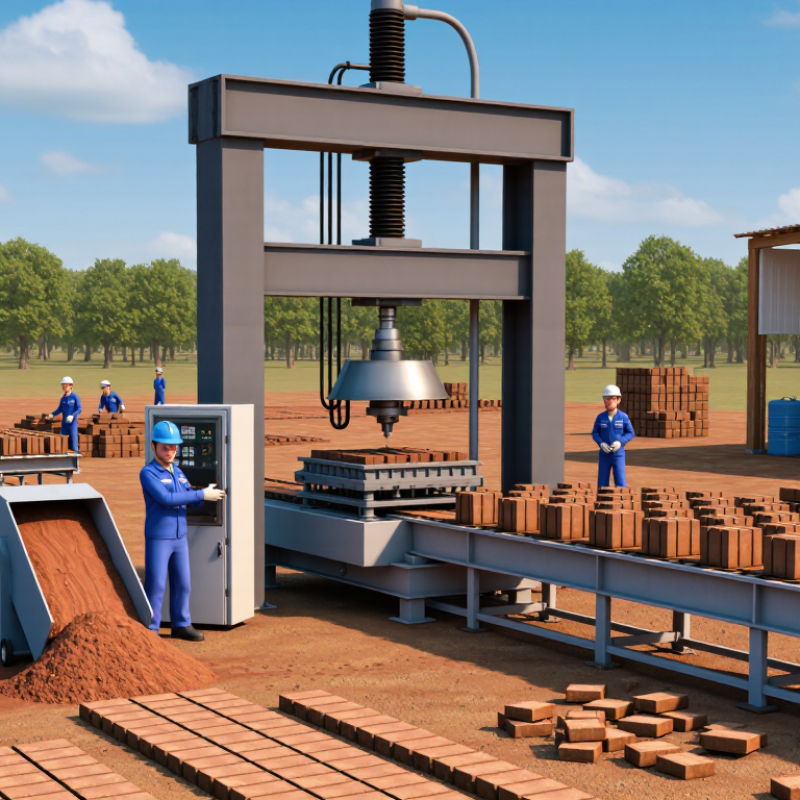
Machine selection should begin with the brick you need, not the machine catalogue. Manual presses suit small projects and local soil trials. Hydraulic presses deliver denser blocks with steadier dimensions. Extrusion machines work continuously, but they need consistent moisture and clay preparation. On a dusty site, a simple soil mixer can matter more than extra pressing force.

Compare capacity carefully.

Small presses may produce 300–800 blocks per hour, while automated lines can exceed 2,000 blocks per hour under controlled conditions. These figures are often ideal, not guaranteed. Soil grading, operator skill, drying space, and mould changes reduce real output. Leave room for error.

Forming method affects strength, surface texture, and repair work.

Compression forming uses pressure to lock soil particles together. Rammed or manually filled moulds cost less, but quality varies between operators. Stabilized earth blocks may improve durability, although additives increase material and testing requirements.

The 2023 Global Status Report for Buildings and Construction reported that buildings represented about 34% of global energy demand and 37% of energy and process-related emissions.

That strengthens the case for lower-energy materials, but energy savings depend on transport, curing, and local soil.

Ask for test records using your soil. Do not trust capacity alone. A machine producing fewer consistent blocks may be the better investment. That is easy to overlook.

Industry guidance from UN-Habitat also emphasizes local material testing and appropriate construction methods, yet field conditions rarely behave perfectly. Recheck the numbers before ordering.

Evaluate Material Compatibility and Brick Quality

Choosing a mud bricks machine starts with the soil, not the machine catalog. Collect samples from several areas of the building site. Soil can change noticeably within a few meters. Test the clay, sand, silt, and organic content before making a purchase. Excess clay may cause cracking during drying. Too much sand can produce weak, crumbly edges. A small hand test can reveal problems early, but laboratory testing offers better confidence.

Match the machine with the prepared material. Some machines handle stiff mixtures, while others need softer, wetter feedstock. Check the required moisture range and mixing method carefully. The material should fill the mold without sticking heavily. I have seen operators add water too quickly. The bricks looked smooth, but later developed uneven shrinkage. That mistake was avoidable. Moisture control matters.

Brick quality depends on more than appearance. Inspect dimensions, corners, density, and surface texture after demolding. Measure several bricks from one production batch. Consistent size reduces mortar use and improves wall alignment. Test sample bricks after proper curing, not immediately. Record compressive strength, water absorption, and visible cracks where practical. A reliable machine should provide adjustable pressure and stable mold dimensions. It should also allow simple cleaning and calibration. In real projects, small inconsistencies become expensive. I still think a slightly slower machine may be better than a fast one that produces unreliable bricks. Performance claims deserve questioning. Local soil conditions, curing space, and operator skill can change the result.

Check Power Needs, Durability, Maintenance, and Safety

Choosing the best mud bricks machine starts with its power demand, not its advertised output. Check motor rating, starting current, voltage stability, and daily operating hours. A machine may run well during testing but fail when clay moisture rises. The U.S. Department of Energy reports that motor-driven systems use about 68% of industrial electricity. Therefore, an efficient motor and correctly sized electrical supply can reduce operating costs. Leave practical capacity, but do not oversize blindly.

Durability depends on the frame, forming chamber, bearings, and wear-resistant contact surfaces. Ask for material specifications and cycle-test evidence, not only photographs. Inspect welds, shaft alignment, and brick dimensions on site. The International Labour Organization reported 2.93 million work-related deaths annually worldwide in 2023. That figure makes guarding and emergency stops essential, not optional. The machine should isolate power before cleaning or removing jammed clay. Small gaps can still trap fingers.

Maintenance should be simple enough for a busy production yard. Choose accessible grease points, replaceable wear parts, clear manuals, and locally available components. Record vibration, unusual noise, fuel use, and rejected bricks each week. A basic log often exposes problems early. I would still question any promised maintenance interval. Dust, abrasive soil, and rushed operators can shorten it significantly. Reference ISO 12100 for risk assessment and IEC 60204-1 for electrical safety, then verify actual safeguards during a supervised trial.

How to Choose the Best Mud Bricks Machine? - Check Power Needs, Durability, Maintenance, and Safety

Evaluation Dimension Manual Press Small Motorized Press Hydraulic Press What to Check Before Buying
Typical application Small projects, remote sites, and low-volume production Small to medium construction projects Medium to high-volume production with more consistent compaction Match machine capacity to the required daily output and available labor
Power requirement No electricity or fuel required Commonly about 2.2–7.5 kW, depending on the drive and compaction system Commonly about 5.5–22 kW for small and medium units Confirm voltage, phase, frequency, starting current, and generator compatibility
Typical production capacity Approximately 300–800 bricks per 8-hour shift Approximately 800–2,000 bricks per 8-hour shift Approximately 1,500–4,000 bricks per 8-hour shift Actual output varies with mold size, soil preparation, cycle time, curing, and operator skill
Compaction consistency Depends strongly on operator technique More consistent than manual pressing when the feed is controlled Generally the most consistent of the three options Request test bricks and check dimensions, density, surface quality, and crack rate
Suitable soil condition Prepared soil with controlled moisture and limited stones Prepared, screened soil with consistent moisture content Well-prepared soil; some systems require a crusher or mixer before pressing Check the recommended particle size, clay content, moisture range, and stabilizer ratio
Frame durability Heavy welded steel frame is preferred for repeated use Requires a rigid frame, protected drive, and reinforced mold area Requires a rigid frame designed to withstand repeated hydraulic loads Inspect weld quality, frame thickness, stress points, corrosion protection, and access to wear parts
Mold and tooling life Wear depends on soil abrasiveness and manual impact Replaceable mold liners reduce long-term downtime Replaceable, wear-resistant molds are important for high-cycle operation Ask about mold material, replacement cost, expected service interval, and available sizes
Maintenance needs Cleaning, bolt inspection, lubrication, and mold adjustment Daily cleaning and lubrication, plus belt, chain, bearing, and motor checks All routine mechanical checks plus hydraulic oil, hoses, seals, and pressure-system inspection Choose a design with accessible grease points, standard components, manuals, and spare parts
Operating skill Basic training; consistent filling and pressing technique are essential Operator needs training in controls, feeding, cleaning, and jam removal Requires trained operators familiar with hydraulic controls and pressure hazards Confirm training materials, operating procedures, and emergency-stop instructions
Key safety features Stable base, guarded pinch points, secure handles, and safe manual loading height Guards on belts and chains, emergency stop, electrical protection, and controlled access All motorized safeguards plus pressure relief, hose protection, and emergency stop Never operate with removed guards; isolate power and release hydraulic pressure before service
Portability Usually easiest to move manually or with a small vehicle May require wheels, lifting equipment, or a suitable transport frame Generally heavier and better suited to a fixed production area Check machine weight, lifting points, transport dimensions, and ground requirements
Best choice when Electricity is unavailable and production volume is modest You need a balance between investment, output, and power consumption High output and repeatable brick density justify higher equipment and maintenance requirements Select the lowest-complexity machine that meets output, quality, safety, and site-power requirements

Note: Capacity and power figures are typical planning ranges for general-purpose soil or mud brick presses. Actual results depend on brick size, soil composition, moisture, stabilizer content, cycle time, and operator practice.

Assess Total Cost, Supplier Support, and Long-Term Value

How to Choose the Best Mud Bricks Machine?

When choosing a mud-brick machine, calculate total cost beyond the invoice. Include molds, mixers, electricity, water, labor, transport, spare parts, and rejected bricks. Then estimate cost per usable brick, not per pressed brick. That difference matters.

The IEA’s Energy Efficiency 2023 report says buildings consume about 30% of global final energy. UNEP’s 2023 Global Status Report links buildings and construction to 37% of global energy- and process-related emissions in 2022. These figures do not prove every earth-block project is automatically sustainable. Local soil testing, drying conditions, and energy sources still decide the result.

Ask suppliers for verified production logs, not only catalog capacity. Request a trial using your soil, with measured cycle time, moisture content, rejection rate, and power use. Support should include operator training, manuals, troubleshooting, and stocked wear parts. Clarify response times and costs before payment.

A phone number is not a service plan. Speak with recent users, if possible. Check whether technicians can reach your site and whether common parts are locally replaceable. An inexpensive machine can become costly after one broken mold or motor. That risk is easy to underestimate.

For long-term value, compare five-year ownership scenarios. Use conservative output, seasonal downtime, inflation, and financing costs. ISO 15686-5:2017 recommends life-cycle costing across acquisition, operation, maintenance, and disposal. A spreadsheet can still lie. Leave room for mistakes.