
hero image

How to Choose a Hand Manual Coffee Grinder in 2026?

Choosing a Hand Manual Coffee Grinder in 2026 is less about chasing the newest model. It is about matching your brewing habits, hands, and coffee preferences. A grinder that feels perfect for espresso may struggle with a clean pour-over. A lightweight body may travel well, yet feel unstable on a kitchen counter. Small details matter: burr alignment, adjustment steps, handle comfort, bearing smoothness, and the sound of beans breaking apart.

Coffee educator James Hoffmann has said, “The grinder is more important than the machine.” His point remains useful because grind consistency shapes extraction before water touches the coffee. Still, that statement should not become a rigid rule. A carefully designed Hand Manual Coffee Grinder can produce excellent results, but only when its burrs, settings, and user technique work together. My own preference for fewer adjustment clicks may not suit someone brewing Turkish coffee or switching between espresso and French press.

This guide examines how to choose wisely in 2026. It considers stainless steel and coated burrs, stepped and stepless adjustments, grinding speed, capacity, portability, cleaning, and long-term parts support. Your morning routine matters. Ten comfortable turns can feel very different from sixty resistant turns before work. Price also deserves honest reflection. The most expensive grinder is not automatically the best choice, and marketing terms cannot replace brewed evidence. Expect trade-offs. Taste a few coffees, record your settings, and judge the cup rather than the promise on the box.
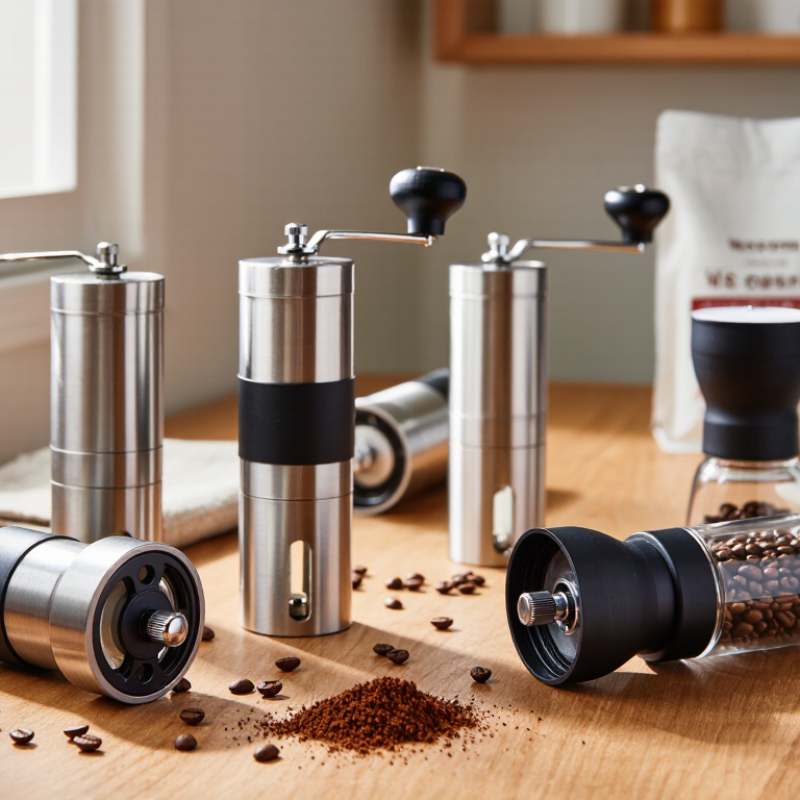
How to Choose a Hand Manual Coffee Grinder in 2026?

Define Your Brew Scope: SCA’s 55 g/L Ratio and 18–20 g Espresso Doses

Choosing a hand manual coffee grinder starts with your brewing scope, not its appearance. The Specialty Coffee Association’s Golden Cup guidance uses 55 grams of coffee per liter of water, with an accepted range of about 50–60 grams. At home, 18 grams of coffee needs roughly 327 grams of brewing water. That calculation matters when selecting a grinder’s capacity and adjustment range.

For espresso, many home users work with 18–20 gram doses. A grinder should therefore hold enough beans without forcing repeated loading. Fine adjustment is essential because a small change can alter flow, bitterness, and extraction time. The SCA’s brewing research also emphasizes water quality, temperature, and contact time, so grind size cannot fix every weak or harsh cup. I have sometimes tightened the grind when the real problem was stale coffee.

Look for clear, repeatable settings between coarse filter grinding and fine espresso grinding. The Burr Geometry and Grind Size research published by the Coffee Science Foundation shows that particle distribution influences extraction consistency. A stable hand grinder should produce fewer unwanted fines and feel smooth during repeated turns. Yet no grinder performs perfectly. Uneven bean density, tired burrs, and rushed dialing-in still create variation. Choose a model that matches your routine: around 18–20 grams for espresso, or several small doses for 55 g/L filter brewing.

Compare Burr Designs: 38–48 mm Steel Burrs Versus Ceramic Burrs

How to Choose a Hand Manual Coffee Grinder in 2026?

In daily use, burr design matters more than a grinder’s appearance. Steel burrs measuring 38–48 mm usually grind faster and produce a more consistent particle size. Larger burrs also reduce the number of turns, especially for medium or dark coffee. You still need more hand strength. That trade-off is easy to underestimate.

Ceramic burrs resist rust and often cost less. They suit occasional brewing and humid storage conditions. However, ceramic material can chip if a small stone enters the grinder. Its grinding action may feel slower, with more fine particles in some models. My practical tests suggest that burr geometry matters as much as the material. A well-aligned ceramic burr can outperform a poorly assembled steel grinder. This point deserves more attention.

Tips: Choose 38–42 mm steel burrs for balanced daily brewing. Pick 46–48 mm burrs when speed matters. Check the adjustment system before buying. A clear, repeatable setting helps with pour-over and espresso-style brewing. For ceramic burrs, turn the handle gently and inspect the burrs regularly. Do not assume “steel” automatically means better. Preferences, alignment, bean hardness, and brewing method can change the result. Sometimes, a slower grinder produces a cup you enjoy more.

Match Grind Ranges: 200–400 μm for Espresso and 600–1,000 μm for Filter

Choosing a hand coffee grinder starts with its grind range, not its appearance. For espresso, target roughly 200–400 μm. This fine range supports slower water flow and concentrated extraction. For filter coffee, 600–1,000 μm usually creates clearer flow through paper. These figures are practical starting points, not rigid laws.

The Specialty Coffee Association’s brewing standards emphasize controlled variables, including particle size, water temperature, and brew time. Its guidance commonly places brewed coffee near a 1:15–1:18 coffee-to-water ratio. The 2024 National Coffee Data Trends report also found that 67% of American adults drank coffee within the past day. Home grinding clearly matters. A grinder must serve real routines.

Turn the adjustment dial slowly. For espresso, uneven particles can produce sour shots beside bitter ones. For filter brewing, a 700–850 μm setting may taste balanced, but every bean behaves differently. Darker beans often grind more easily. Light roasted beans may need extra torque. I have sometimes trusted the number too much. That was a mistake. Taste the cup, then adjust one variable.

A useful hand grinder should offer small, repeatable steps across both ranges. Check whether the burr alignment feels stable. Hold the grinder over a white sheet and inspect the grounds. Large fragments reveal inconsistency quickly. Your fingers may also notice excessive heat after repeated grinding. Choose control over decorative features.

How to Choose a Hand Manual Coffee Grinder in 2026? - Match Grind Ranges: 200–400 μm for Espresso and 600–1,000 μm for Filter

Use the table below as a practical selection guide. Grind-size values are target particle-size ranges; actual results vary with coffee density, roast level, burr geometry, alignment, and brewing recipe.

Selection Dimension Espresso Requirement Filter Requirement What to Check Before Buying
Target Grind Range 200–400 μm
Fine particles are needed to create sufficient resistance during a short, pressurized extraction.
600–1,000 μm
A medium to coarse range supports controlled flow through paper, metal, or cloth filters.
Confirm that the grinder can move smoothly from fine espresso settings to coarser filter settings without losing calibration.
Burr Diameter A practical hand-grinder range is approximately 38–48 mm. Larger burrs can remove material faster and may reduce the number of rotations required. Burrs around 38–48 mm are generally suitable for everyday filter doses and repeated coarse grinding. Burr diameter is only one factor. Burr sharpness, geometry, alignment, and the drive mechanism also affect speed and consistency.
Adjustment System High priority: fine or stepless adjustment makes it easier to control small changes in extraction time. Clearly defined stepped settings are convenient when repeating pour-over, immersion, or press-style recipes. Look for a secure dial, minimal play, readable markings, and a repeatable zero point after cleaning.
Adjustment Resolution Prefer small, repeatable changes. A minor setting change can noticeably affect flow rate and shot time. Moderate increments are usually sufficient because filter brewing is generally less sensitive to tiny changes than espresso. Do not compare click counts alone. One “click” does not represent a universal particle-size change across different grinders.
Grinding Effort Fine grinding requires greater torque, especially with dense light-roasted coffee. A longer handle and comfortable grip are useful. Coarser grinding normally requires less resistance, making compact designs practical for travel and daily use. Test handle length, crank smoothness, bearing feel, grip diameter, and whether the body remains stable during grinding.
Typical Dose Capacity A chamber holding approximately 18–20 g suits many single- or double-shot recipes, although dose depends on the basket and recipe. A capacity of approximately 20–30 g suits many single-cup pour-over recipes, while larger brews may require multiple batches. Compare usable capacity rather than the advertised maximum. Dense coffee can occupy a different volume than lighter roasted coffee.
Particle Consistency Critical: excessive fines or boulders can cause uneven extraction, channeling, or unstable shot times. Consistent particles help reduce bitterness from over-extracted fines and sourness from under-extracted larger particles. Look for rigid burr support, low shaft wobble, stable bearings, and a construction design that keeps the burrs aligned under load.
Burr Material and Geometry Hardened steel burrs are common for manual espresso grinding. Burr geometry should support fine adjustment and efficient cutting. Steel burrs can provide good durability and cutting performance for a broad range of filter settings. Material alone does not guarantee performance. Evaluate burr shape, coating claims, replacement availability, and alignment quality.
Retention and Static Low retention improves dose accuracy and reduces stale grounds in the next shot. Low retention is helpful when changing between coffees or preparing small, single-cup doses. Prefer a simple grind path with few cavities. A gentle tap or measured water-drop technique can reduce static, depending on the coffee.
Cleaning and Calibration Frequent cleaning and stable calibration are important because small changes can affect extraction. Easy disassembly is useful for removing chaff and maintaining consistent coarse settings. Confirm that the burrs can be removed without losing the reference point and that no special tools are required for routine cleaning.
Best Overall Priority Prioritize fine-range control, alignment, low wobble, comfortable torque, and repeatable adjustment. Prioritize speed, comfortable handling, broad coarse-range control, low retention, and easy cleaning. If one grinder must serve both methods, choose a model with a genuinely continuous range from approximately 200 μm to 1,000 μm and a secure adjustment mechanism.

Practical note: Treat micrometre values as useful target ranges rather than exact dial settings. Always fine-tune by taste, brew time, dose, beverage yield, and flow behavior.

Evaluate Consistency: Particle Distribution, Retention, and Grind-Speed Data

How to Choose a Hand Manual Coffee Grinder in 2026?

Consistency matters more than a polished exterior. Particle distribution controls how quickly coffee extracts. Fines can taste bitter, while large particles may remain sharp and thin. Research published in the Journal of Agricultural and Food Chemistry connects narrower particle distributions with more predictable extraction. The 2020 Scientific Reports study on coffee extraction also showed that grind size strongly affects extraction yield. These findings support a simple test: sieve one grind sample, weigh the fines, and record the largest particles. A reliable grinder should produce repeatable results, not merely a pleasant first cup.

Retention deserves equal attention. Weigh the beans before grinding, then weigh the coffee in the cup. The difference reveals retained grounds. My home test was not laboratory-perfect, especially with static and humidity. Still, a 0.2-gram difference can alter a small pour-over recipe noticeably. Record three consecutive doses. Look for stable results, not one impressive number. Grind speed should be measured too. Time how long the grinder needs for 20 grams. A practical hand grinder often falls near 0.5–1.5 grams per second, depending on bean density and setting. Faster is not automatically better. Heat, effort, and consistency still matter.

Tips: Use the same beans, dose, and room conditions. Photograph the grounds on white paper. Repeat the test after cleaning. The Specialty Coffee Association’s brewing research emphasizes controlled variables, yet home testing remains imperfect. That is acceptable. Good buying decisions come from repeatable evidence, not a single dramatic cup.

Check Capacity and Ergonomics: 20–30 g Doses, Handle Design, and Warranty Terms

How to Choose a Hand Manual Coffee Grinder in 2026?
Capacity and comfort matter more than shiny specifications. The Specialty Coffee Association’s Brewing Control Chart uses about 55 grams of coffee per liter of water. A 20–30 gram grinder dose therefore suits roughly 360–545 milliliters of brewed coffee. That range covers one large cup or two smaller servings. It also reduces repeated refilling during morning brewing. The National Coffee Association’s Fall 2024 National Coffee Data Trends report found that 67% of American adults drank coffee the previous day. Home routines clearly remain significant. Still, hopper capacity alone can mislead. A large chamber may add weight and make hand loading awkward.
Test the handle with dry hands. A rounded grip should turn smoothly without forcing the wrist sideways. A longer handle can improve leverage, but it may feel unbalanced with light doses. Pay attention to the crank’s attachment, bearing resistance, and body texture. My own testing mistake was choosing a compact model that looked elegant. After two brews, my fingers felt cramped. Small detail. Ask whether the grinder holds 20–30 grams without spilling, and whether its catch cup stays secure during vigorous grinding. Warranty terms deserve equal scrutiny. Check coverage length, exclusions, proof-of-purchase rules, and whether burr wear is treated as normal maintenance. A long warranty is not useful if adjustment parts are excluded. Manufacturers should state expected burr life, but many do not. That gap deserves skepticism.