7 Best Frying Oil Filter Paper Suppliers for Global Buyers?
Choosing the right Frying Oil Filter Paper can affect oil clarity, equipment performance, and food quality. Global buyers need more than attractive pricing. They need dependable materials, consistent filtration, and suppliers that communicate clearly across borders.
This guide reviews seven leading suppliers for commercial kitchens, food processors, and equipment distributors. The evaluation considers paper grade, filtration precision, heat resistance, sheet or roll formats, minimum order quantities, and export experience. Supplier documentation also matters. Technical data sheets, batch records, product samples, and quality certifications can reveal more than a polished website. Small details count.
Real purchasing experience shows that no supplier is perfect for every application. One may offer excellent customization but slower production. Another may provide competitive pricing but limited regional support. A buyer filtering dark oil with fine particles may need a different paper grade from a restaurant changing oil daily. Testing remains essential. A sample run can expose leakage, tearing, excessive absorption, or poor fit around a filter frame.
This overview aims to help buyers compare options with practical judgment. It highlights supplier strengths, possible limitations, and questions worth asking before a contract. Claims should be verified directly with each manufacturer, especially regarding food-contact compliance, shipping terms, and production capacity. Markets change. Supplier performance can change too. Reliable sourcing requires evidence, not assumptions.
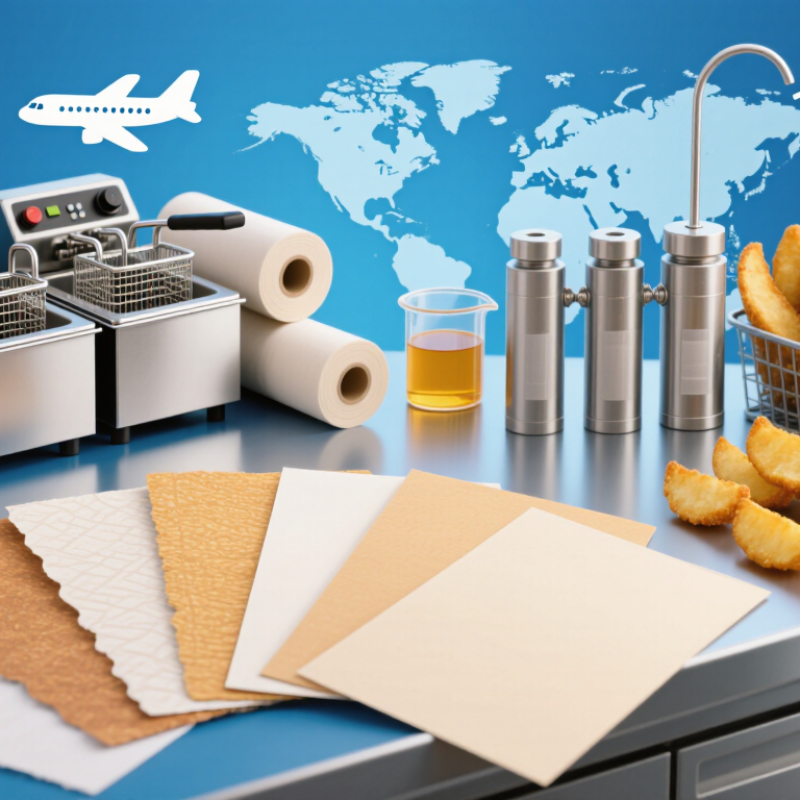
What Frying Oil Filter Paper Is and Why Global Buyers Need It
Frying oil filter paper is a food-grade sheet made from cellulose or blended fibers. It removes crumbs, batter particles, and dark carbon deposits from used cooking oil. Cleaner oil can improve flavor, color, and frying consistency. It may also reduce waste because operators can reuse oil more carefully, within their own safety procedures.
Global buyers need reliable filter paper for busy kitchens, food factories, and catering operations. Paper must match the fryer, oil temperature, flow rate, and filtration equipment. Thickness, pore size, wet strength, and sheet dimensions all affect performance. Buyers should request food-contact documentation, testing records, packaging details, and stable production capacity. A low price is not always economical. Thin paper may tear, while overly dense paper can slow filtration. This is easy to overlook.
Tips: Test samples with real oil, not water alone. Check whether the paper releases fibers or changes the oil’s smell. Ask suppliers for batch consistency and export packaging. Confirm storage conditions, because humidity can weaken paper before use. No filter fixes overheated oil. My practical view is simple: filtration supports oil management, but staff still need temperature control and regular quality checks.
Key Specifications for Comparing Frying Oil Filter Paper Suppliers
When comparing frying oil filter paper suppliers, start with measurable specifications, not attractive catalog images. Commercial papers commonly range from 40 to 80 g/m², but weight alone does not prove filtration performance. Ask for pore-size distribution, filtration flow rate, wet strength, and maximum operating temperature. A 2023 report from the International Food Information Council noted that consumers increasingly value food safety and processing transparency. That pressure also affects fryer maintenance.
Food-contact compliance should be documented clearly. Request migration-test results, a declaration of compliance, and batch-level certificates of analysis. Suppliers should identify pulp composition, bleaching method, adhesive content, and any processing aids. The FDA Food Code 2022 emphasizes hygienic equipment maintenance, while Codex food-hygiene guidance supports traceable controls throughout food operations. Paper that tears inside a hot fryer is not merely inconvenient. It can leave fibers, slow production, and increase cleaning time.
Compare sheet dimensions, roll tolerance, packaging quality, minimum order quantity, and delivery consistency. For high-volume kitchens, test actual flow using the same oil temperature and fryer model. Measure filtration time, oil clarity, sediment removal, and paper failure rate. A 2024 food-processing report by MarketsandMarkets identified automation and process efficiency as continuing industry priorities. Yet supplier samples can perform better than routine shipments. That is where buyers should remain cautious. Request three production batches, not one perfect sample. Your evaluation may still miss seasonal variation, but it will reveal more than a specification sheet.
7 Best Frying Oil Filter Paper Suppliers for Global Buyers? - Key Specifications for Comparing Frying Oil Filter Paper Suppliers
Comparative benchmark of commonly requested technical, commercial, and compliance specifications for frying oil filter paper suppliers.
| Supplier Profile | Primary Supply Region | Filter Medium | Typical Filtration Rating | Basis Weight | Common Sheet or Roll Sizes | Recommended Oil Temperature | Food-Contact Documentation | Typical MOQ | Typical Lead Time | Best-Fit Buyer |
| Supplier 1 | East Asia | Bleached cellulose paper | 10–25 μm nominal | 45–60 g/m² | Standard discs, 200–600 mm; custom rolls | Up to approximately 180°C, subject to grade | Food-contact declaration and migration test available on request | 500–1,000 kg | 15–30 days | Quick-service restaurants and fryer-service distributors |
| Supplier 2 | South Asia | Natural cellulose filter paper | 20–40 μm nominal | 50–80 g/m² | Flat sheets, 300–800 mm; center-fold formats | Typically 150–175°C during filtration | Declaration of composition; regional compliance documents vary | 300–800 kg | 20–35 days | Cost-sensitive wholesalers and regional food-service buyers |
| Supplier 3 | Southeast Asia | Wet-strength cellulose paper | 15–35 μm nominal | 55–90 g/m² | Round discs, 250–700 mm; die-cut shapes | Up to approximately 175°C, depending on process time | Food-grade raw-material statement and batch traceability commonly offered | 500–1,500 kg | 18–32 days | High-volume kitchens requiring improved wet handling |
| Supplier 4 | Western Europe | High-purity cellulose paper | 5–20 μm nominal | 40–75 g/m² | Precision discs and laboratory-style sheets | Typically 160–180°C with controlled filtration | EU food-contact declaration, technical data sheet, and traceability records | 100–500 kg | 10–25 days | Premium importers and buyers prioritizing documentation |
| Supplier 5 | North America | Cellulose paper with optional support layer | 10–30 μm nominal | 50–100 g/m² | Fryer-compatible pads, bags, and custom die-cuts | Approximately 150–180°C, based on equipment design | Food-contact compliance statement and supplier audit package commonly available | 250–1,000 kg | 15–30 days | Restaurant chains seeking customized fryer-pad formats |
| Supplier 6 | Eastern Europe | Reinforced cellulose filter media | 20–50 μm nominal | 70–120 g/m² | Large sheets, 500–1,000 mm; continuous rolls | Typically 150–170°C for commercial frying oil | Technical data sheet, safety documentation, and batch certificates available by order | 1,000–2,000 kg | 25–45 days | Industrial fryer operators and bulk distributors |
| Supplier 7 | Multi-region export supplier | Cellulose paper with optional filter-aid compatibility | 10–40 μm nominal | 45–100 g/m² | Standard discs, sheets, rolls, and custom packaging | Approximately 150–180°C, subject to product validation | Food-contact declaration, certificate of analysis, and export documentation | 500–2,000 kg | 20–40 days | Global buyers needing consolidated sourcing and private-label packing |
Buyer note: Micron rating, basis weight, temperature suitability, flow rate, wet strength, and food-contact compliance should be confirmed through a current technical data sheet and sample testing. Filtration temperature must follow the paper grade and the fryer equipment manufacturer's operating instructions.
Seven Leading Frying Oil Filter Paper Suppliers for International Buyers
Seven Leading Frying Oil Filter Paper Suppliers for International Buyers
International buyers need more than a low quotation. They need stable filtration, food-contact documentation, and dependable export support. USDA Economic Research Service data shows that food-away-from-home spending represented about 58% of U.S. food expenditure in 2023. That demand increases pressure on commercial kitchens to control oil quality and operating costs.
The seven leading supplier groups usually include manufacturers with high-speed paper lines, regional converters, custom-size producers, sustainable-fiber specialists, private-label exporters, industrial filtration companies, and distributors with local inventory. Each group serves a different purchasing need. Buyers should check basis weight, wet strength, filtration speed, ash content, and roll or sheet tolerance. A filter that tears beside a fryer is not a bargain.
FDA Food Code 2022 emphasizes using food-contact materials safely and maintaining equipment in sanitary condition. International buyers should request migration testing, material declarations, batch traceability, and clear storage instructions. ISO 9001 certification can support process consistency, but it does not replace product testing. Ask for samples in hot oil conditions. Small differences matter.
A practical trial should measure filtering time, oil clarity, paper consumption, and disposal volume. Compare results across several batches, not one perfect test. Supplier claims can sound precise. Your fryer may disagree. Pricing also deserves caution; cheaper paper can increase labor and replacement frequency. I would review technical files with a local compliance specialist before approving a long-term contract.
How to Evaluate Supplier Quality, Compliance, and Production Capacity
Choosing among the 7 best frying oil filter paper suppliers requires more than comparing prices. Inspect food-contact declarations, migration test reports, and batch traceability. The FDA Food Code 2022 emphasizes preventing contamination through suitable food-contact materials. In Europe, Regulation (EC) No. 1935/2004 requires materials to remain safe during intended use. A reliable supplier should explain paper fiber sources, bleaching methods, adhesive controls, and storage conditions.
Production capacity needs practical verification. Ask for monthly output, machine numbers, lead times, and backup plans for pulp shortages. The ISO Survey 2022 recorded more than 1.26 million ISO 9001 certificates worldwide, but certification alone proves limited process control. It does not guarantee every shipment. Request recent certificates, internal audit summaries, and three consecutive batch samples. Check pore size, wet strength, filtration speed, and oil-temperature performance under real operating conditions. Small defects matter.
Tips: Build a supplier scorecard with quality, compliance, capacity, and response time. Require sealed packaging, lot codes, and retention samples. Compare results from independent laboratories when claims seem unusually perfect. FAO reported that 13.2% of food was lost globally before retail in 2021. Better filtration cannot solve all losses, but poor paper quality can increase oil waste, downtime, and inconsistent cooking results. A site audit is valuable, though travel budgets often make remote evidence necessary. Do not confuse polished documents with dependable production.
7 Best Frying Oil Filter Paper Suppliers for Global Buyers
How to Evaluate Supplier Quality, Compliance, and Production Capacity
The chart presents an illustrative 100-point qualification model for comparing frying oil filter paper suppliers. Food-contact compliance, quality assurance, production capacity, traceability, and delivery resilience should be verified through current documentation, audits, test reports, and production records rather than company claims alone.
Ordering, Shipping, and After-Sales Factors for Global Procurement
7 Best Frying Oil Filter Paper Suppliers for Global Buyers?
Global buyers should compare suppliers through samples, documentation, and delivery performance. Ask for food-contact declarations, material composition, micron ratings, and batch traceability. A reliable supplier can explain how the paper performs with hot oil, repeated filtration, and different fryer designs. Request a small trial order. Seven suppliers may look similar online, but their paper strength can differ noticeably after soaking.
Ordering details deserve careful review. Confirm sheet size, roll width, core diameter, packing method, and monthly capacity before payment. Request a clear quotation with production time, minimum order quantity, payment terms, and shipping conditions. Moisture-resistant cartons and sealed inner bags help protect filter paper during ocean transport. Check pallet dimensions, gross weight, export documents, and destination port requirements. Delays often begin with incomplete paperwork, not production.
After-sales support should be measurable. Ask how quickly the supplier handles damaged cartons, incorrect sizes, or inconsistent filtration results. Useful support includes replacement policies, inspection photos, batch records, and a named contact person. In one purchasing review, the lowest price seemed attractive, but weaker paper increased waste and labor costs. We also overlooked warehouse humidity. That mistake was avoidable. A short pilot order, written quality standards, and retained samples create stronger evidence than promises alone.