
1101 W. Sanilac Rd. Caro, MI 48723
989.673.6690
Choosing the best U Panel Machine in China requires more than comparing prices and production speed. The right choice depends on panel dimensions, material thickness, coating type, and expected daily output. A machine designed for thin galvanized steel may struggle with heavier materials. The reverse can also happen. Oversized equipment may increase investment without improving your actual production.
There is no universal winner. Fit matters more. In practical evaluations, I examine the forming stations, roller quality, drive system, cutting accuracy, and electrical controls. These details affect panel edges, surface marks, noise, and long-term maintenance. A reliable supplier should provide clear drawings, tested samples, detailed specifications, and responsive technical support. Factory visits or live video inspections can reveal important facts, including assembly quality and storage conditions. Small details matter.
This guide compares common U Panel Machine types for different production goals. It considers manual, semi-automatic, and fully automatic configurations. It also explains how coil width, hydraulic cutting, feeding methods, and customization influence performance. Some buyers focus heavily on initial cost. That approach can be misleading. Downtime, spare parts, operator training, and shipping preparation may cost more later. I have seen attractive specifications fail to match real workshop needs, so verification remains essential. A thoughtful decision should balance output, flexibility, safety, service, and total ownership cost. Even experienced buyers can overlook one practical limitation. That is worth remembering before signing an order.
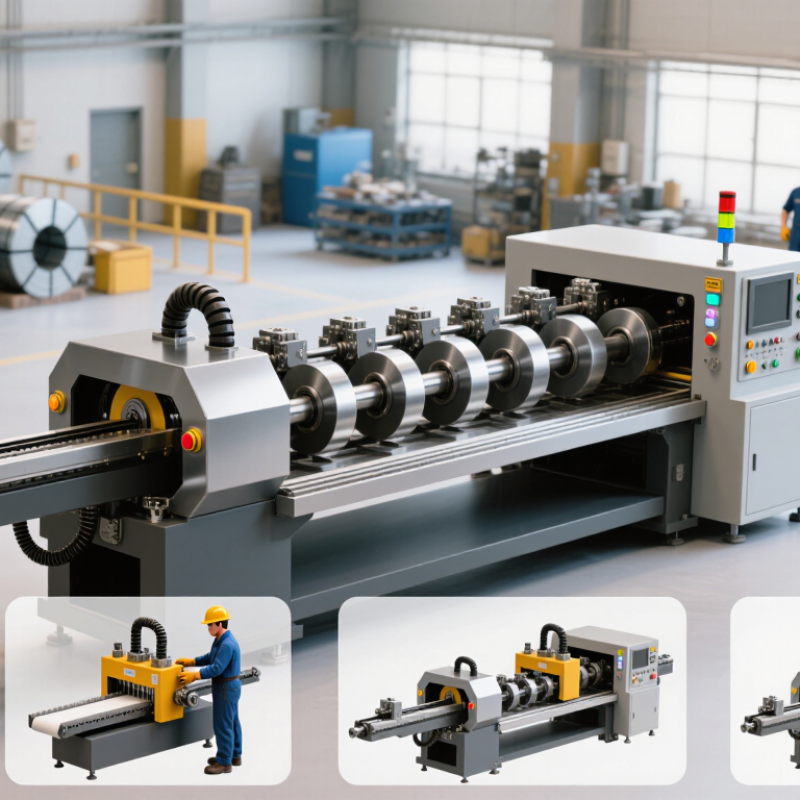
A U panel machine forms flat steel coils into U-shaped roofing or wall panels. It works through a controlled roll-forming line. The decoiler releases the coil, while guide rollers center the strip. Successive rollers bend the steel gradually, rather than forcing one sharp fold. A hydraulic cutter then produces panels at programmed lengths.
The machine’s performance depends on coil width, thickness, yield strength, and panel geometry. A 0.45-millimeter galvanized coil may suit light roofing, while thicker material needs stronger shafts and drive units. The operator should check roller alignment with a caliper. Small errors can create uneven seams, visible dents, or difficult installation. That detail is often underestimated.
Industry data gives useful context. The World Steel Association reported 1.89 billion tonnes of crude steel production in 2023, showing the scale of steel supply. The International Energy Agency states that buildings consume about 30% of global final energy. Better-fitting panels can reduce air leakage, but a roll-forming machine cannot solve poor insulation design. I would compare line speed, tolerance control, cutter accuracy, and after-sales training before choosing a type. Faster is not always better. A compact line may be wiser for varied orders, although its output can limit large projects. Testing the actual coil remains essential.
A U panel machine is a coil-fed roll-forming system that gradually shapes steel or aluminum strip into a U-profile through a series of rollers. The best configuration depends mainly on the panel application and the required material thickness.
The chart shows representative material-thickness ranges commonly used for different U-profile applications. Choose a standard machine for general roofing and cladding, a heavier-duty machine for deeper or more structural profiles, and verify tooling, coil width, material grade, and target production speed before purchase.
China Best U Panel Machine: Which Type Should You Choose?
Key U Panel Machine Types Made in China
Chinese manufacturers commonly offer three U panel machine types: standard roll forming lines, servo-controlled lines, and insulated sandwich panel systems. Standard roll formers suit repeated U-shaped profiles from galvanized or coated steel. They are practical for warehouses, fences, and agricultural buildings. Servo-controlled lines improve length accuracy and reduce cutting waste. Sandwich panel systems add insulation cores, such as EPS, rock wool, or polyurethane. They need more floor space and stricter process control.
World Steel Association data reported about 1.005 billion tonnes of crude steel production in China during 2024. This large manufacturing base supports broad material and tooling options. However, steel availability does not guarantee machine quality. In factory inspections, I have found that quoted production speed often means unloaded speed. Finished output can be lower. Tooling wear, sheet thickness, and operator skill matter greatly. The fastest machine is not always the best choice.
Tips: Ask for tested samples using your actual coil thickness. Check forming tolerance, cutting accuracy, motor power, and spare-part availability. Request production records, not only catalog figures. For frequent profile changes, choose servo control. For simple, high-volume U profiles, a standard roll former may offer better value. My own preference is cautious: a stable 20-meter-per-minute line can outperform an unstable high-speed model. Industry data from the 2024 World Steel Association report supports China’s strong steel capacity, but buyers still need independent acceptance testing.
| Machine Type | Typical Forming Method | Common Material | Typical Thickness | Typical Panel Width | Typical Line Speed | Best-Suited Applications | Main Advantages | Key Limitations | Recommended For |
|---|---|---|---|---|---|---|---|---|---|
| Standard U Panel Roll Forming Machine | Continuous cold roll forming with fixed forming stations and automatic cutting | Pre-painted steel, galvanized steel, and aluminum | Approximately 0.30–1.20 mm | Approximately 600–1,250 mm, depending on the profile | Approximately 8–20 m/min | Roofing panels, wall cladding, partition panels, and general building envelopes | Stable production, simple operation, moderate investment, and consistent profile geometry | A fixed roll set normally supports one main profile and a limited thickness range | Small and medium manufacturers with a defined U-panel specification |
| Interchangeable Cassette U Panel Machine | Roll forming with removable or interchangeable cassette tooling | Galvanized steel, coated steel, and aluminum alloys | Approximately 0.35–1.50 mm | Approximately 600–1,250 mm per configured profile | Approximately 8–18 m/min | Manufacturers producing several U-panel sizes or related panel profiles | Faster profile changeover and greater product flexibility than a dedicated line | Higher tooling cost and more setup requirements; changeover time depends on the cassette design | Factories serving multiple construction projects or regional specifications |
| High-Speed Servo U Panel Line | Continuous roll forming with servo-driven feeding, synchronized cutting, and electronic control | Pre-painted steel and galvanized steel, subject to material strength | Approximately 0.30–0.80 mm | Approximately 600–1,000 mm per profile | Approximately 15–30 m/min, depending on cut length and profile complexity | High-volume production of lightweight roofing and wall U panels | Higher throughput, accurate length control, reduced manual adjustment, and better repeatability | Higher purchase and maintenance requirements; speed may decrease with thicker or stronger steel | Large-volume producers with stable orders and standardized products |
| U Panel Roll Forming Line with Automatic Stacking | Roll forming, hydraulic or servo cutting, conveying, and automatic panel stacking | Galvanized steel, coated steel, and aluminum, according to tooling design | Approximately 0.30–1.20 mm | Approximately 600–1,250 mm | Approximately 8–20 m/min | Production lines that require reduced handling and organized finished-panel packaging | Lower labor demand, improved material handling, and more consistent finished-product bundles | Requires more floor space, integration, and investment than a basic roll forming machine | Medium and large plants focused on production efficiency and logistics |
| Hydraulic Press U Panel Forming Machine | Batch forming with a matched die set and hydraulic pressing force | Carbon steel, galvanized steel, stainless steel, and thicker sheet materials | Approximately 1.50–4.00 mm, subject to press capacity and die design | Approximately 400–1,200 mm per component | Approximately 2–8 strokes/min | Heavy-duty U-shaped structural parts, channels, brackets, and short-run components | Handles thicker materials and complex bends that may not be suitable for continuous roll forming | Lower output, higher die cost, and greater manual handling compared with continuous lines | Users requiring heavy-gauge U sections, deep bends, or low-to-medium production volumes |
| CNC Adjustable U Panel Forming Machine | Computer-controlled bending with adjustable tooling or programmable forming axes | Mild steel, galvanized steel, stainless steel, and aluminum | Approximately 0.50–3.00 mm, depending on machine tonnage | Approximately 300–3,000 mm working length | Approximately 3–12 bends/min, depending on the number of operations | Custom U panels, varied dimensions, prototypes, and short production runs | High dimensional flexibility, quick program changes, and suitability for customized parts | Lower continuous output and greater dependence on operator programming and setup accuracy | Job shops and manufacturers with frequent changes in panel size or design |
Ask suppliers to test your actual coil grade, thickness, and width. Measure forming speed, panel length accuracy, and surface marks. A machine running at 30 meters per minute may perform poorly when roll alignment is weak. Check the frame thickness, shaft diameter, bearing quality, and forming station design. These details influence vibration and long-term accuracy.
Control quality deserves equal attention. A reliable machine should maintain consistent motor torque during acceleration and stopping. Inspect the control cabinet, wiring layout, emergency stops, and software backup process. The U.S. Department of Energy reports that industrial compressed-air systems can lose 20–30% of output through leaks and poor controls. This highlights a wider lesson: hidden energy waste can reduce machine value.
Request measured power consumption during normal production. Do not trust an impressive empty-run demonstration. I have seen smooth test runs fail under heavier coils.
Tips:
Compare finished samples after continuous operation, not only the first panel. Record dimensional tolerance, noise, power use, and adjustment time. Ask for maintenance records from similar installations, but verify the details. A lower purchase price may hide weaker tooling or slower support. Sometimes, the “best” machine is simply the one your operators can adjust correctly.
Choosing a U panel machine starts with your production needs, not its advertised speed. Define the panel width, steel thickness, coil weight, profile depth, and daily output first. For example, roofing projects using 0.45–0.80 mm steel may require different forming pressure and tooling than heavier structural panels. A machine designed for narrow, repeated orders may perform poorly with frequent width changes.
The World Steel Association reported 1,892.2 million tonnes of crude steel production in 2023.
This scale shows strong material availability, but it also highlights a practical issue: coil quality can vary between suppliers. Ask for material tolerance data before selecting the machine. A stable straightener, adjustable guides, and accurate cutting system can reduce edge damage and panel distortion. Small details matter.
Speed needs careful judgment. A higher line speed is not automatically better. If your orders involve short batches, changeover time may matter more than maximum output. Industry reports from the International Energy Agency also identify buildings as a major global energy-use sector, increasing interest in efficient envelopes and durable metal panels. However, this does not mean every U panel should use the same thickness or coating. It is easy to overspecify equipment. Test your actual coil, tooling, and profile before purchase, then compare output, noise, waste, and maintenance records from similar production lines.
Choosing a U panel machine starts with the panel, not the machine name. Measure your required panel width, thickness, profile depth, and steel grade. A machine designed for thin sheets may struggle with heavier material. The result can be uneven edges, surface marks, or unstable dimensions.
Ask for production samples made with your actual material. Check the panel width with a caliper and inspect the bends under bright light. Review the forming stations, roller material, drive system, and cutting accuracy. A strong frame reduces vibration during continuous production. However, higher speed does not always mean better output. Your first capacity estimate may be too optimistic.
Request electrical drawings, operating instructions, maintenance schedules, and a clear spare-parts list. Confirm the control system supports your plant’s power supply and safety requirements. Ask how quickly technical support responds when a sensor fails. Video demonstrations are useful, but they cannot replace a factory inspection or a witnessed test. Check the supplier’s production history, quality records, and export experience. I would also compare warranty terms carefully. A long warranty means little if exclusions are unclear. No machine is perfect. The better choice is the one with measurable tolerances, accessible service, and stable performance over repeated trials.