
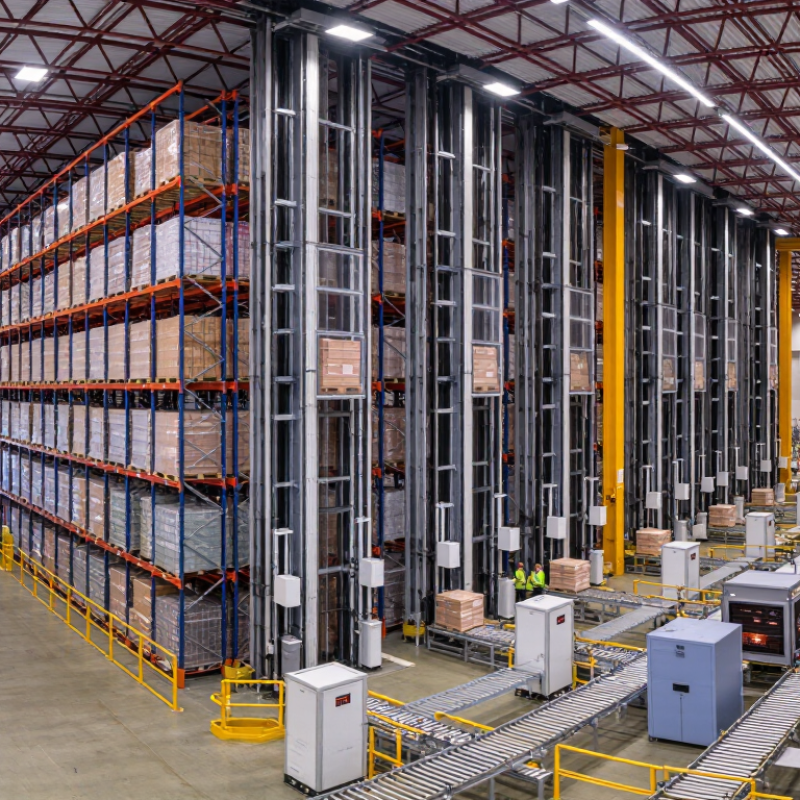
hero image

Why Choose High Speed Lifts for Global Warehouses?

Modern warehouses face relentless pressure to move goods faster, higher, and more accurately. High Speed Lifts can connect receiving docks, storage levels, and picking zones within seconds. They reduce waiting time around busy vertical transport points. That matters when pallets arrive continuously and order deadlines tighten.

Dr. Albert So, an elevator safety researcher and industry educator, has stated, “Speed matters only when safety, control, and reliability remain balanced.” This principle guides responsible warehouse planning. A faster lift cannot compensate for poor loading practices or weak maintenance. It must match the building’s traffic pattern, shaft height, payload, and operating schedule. Sensors, braking systems, door controls, and emergency communication require careful evaluation. Small delays can reveal larger design problems.

High Speed Lifts may also support narrower layouts. They can shorten travel distances and release valuable floor space for inventory. However, higher speed can increase energy demand, mechanical wear, and installation costs. That assumption can fail. A slower system may sometimes deliver better lifetime value. Decision-makers should compare cycle times, service access, noise levels, and total ownership costs. They should also examine local safety requirements before installation.

The strongest choice comes from measured warehouse data, not impressive specifications. Test the busiest routes. Study real pallet weights. Review maintenance records from comparable facilities. Then select equipment that performs consistently during peak shifts. High Speed Lifts are powerful tools, but only when engineering discipline supports their speed.
Why Choose High Speed Lifts for Global Warehouses?

What Are High Speed Lifts in Modern Warehouses?

High speed lifts are vertical material-handling systems designed to move pallets, cartons, and totes between warehouse levels quickly. Unlike passenger elevators, they are built for repeated industrial cycles, controlled loading, and predictable positioning. A typical system includes a lifting platform, guide rails, sensors, gates, and safety interlocks. These parts work together to reduce manual carrying and connect receiving areas with storage or dispatch zones.

In modern warehouses, high speed lifts support dense layouts where floor space is limited. A pallet can travel several levels while workers remain on the ground floor. This may shorten travel routes and improve order flow. However, speed alone is not enough. Lift capacity, door timing, pallet dimensions, and software coordination must match the warehouse process. In my experience, poor layout planning can make a fast lift feel slow. Maintenance access also deserves attention, because small sensor faults can interrupt an entire vertical route.

Tips: Measure peak loads, not average loads. Leave space for safe maintenance. Test mixed pallet sizes before final installation. Review emergency procedures with operators. A slower cycle may be wiser when stability, noise, or fragile goods matter. Reliable performance comes from balanced design, not maximum speed.

How High Speed Lifts Improve Warehouse Operations

High speed lifts can change the rhythm of a global warehouse. They move pallets, cages, and cartons between levels with fewer waiting periods. In busy facilities, this improves order flow and reduces congestion near loading areas. Operators can transfer goods during narrow dispatch windows. That matters when shipments cross several time zones. Faster movement also supports better use of vertical space, especially where floor area is expensive.

Tips: Measure lift cycle time during real shifts, not only during testing. Check door alignment, loading weight, and stopping accuracy each day. Keep pedestrian routes separate from lift access. Train operators to report unusual vibration or delayed doors immediately. Small faults often become costly delays. However, speed alone is not enough. A poorly planned lift position can increase walking distance and create new bottlenecks. That mistake is easy to miss.

Reliable performance requires more than a powerful motor. Warehouse teams should review throughput, maintenance records, noise levels, and emergency procedures together. Use sensors and inspection logs to identify repeated failures. Leave enough service access around the equipment; cramped spaces slow repairs. The best results usually come from matching lift speed to actual demand. Extremely fast movement may add little value in a low-volume zone. Human judgment still matters.

Why Choose High Speed Lifts for Global Warehouses? - How High Speed Lifts Improve Warehouse Operations

Typical engineering comparison for a vertical warehouse lift serving a 10 m travel height. Actual performance depends on load, building layout, door configuration, controls, and local safety requirements.

Operational Dimension Conventional Freight Lift High Speed Lift Operational Improvement
Rated lifting speed Approximately 0.30 m/s Approximately 1.00 m/s Up to 3.3 times faster vertical movement, subject to the selected equipment configuration.
Travel time for a 10 m rise About 33 seconds About 10 seconds Approximately 23 seconds saved per vertical trip, excluding door and loading time.
Typical complete cycle time About 80 seconds About 48 seconds Faster travel and coordinated door operation can reduce repeated waiting between warehouse levels.
Estimated theoretical cycles per hour Approximately 45 cycles/hour Approximately 75 cycles/hour Around 67% higher cycle capacity when the lift is continuously available and loading conditions are comparable.
Rated load range commonly used in warehouses 1,000–2,000 kg 1,000–2,000 kg High speed does not require reducing payload when the lift structure, drive, and controls are correctly specified.
Order-picking response More waiting during frequent level changes Shorter response time between storage and dispatch levels Supports faster replenishment, picking, kitting, and transfer of completed orders.
Peak-period throughput More likely to become a vertical-flow bottleneck Better suited to high-frequency material movement Helps balance conveyor, mezzanine, shelving, and packing-station capacity during busy periods.
Labor utilization Operators spend more time waiting for lift arrival Operators can complete more tasks within the same shift Reduces non-value-added waiting time without requiring additional floor space.
Control-system integration Basic call-and-send operation is common Can be integrated with warehouse control systems, scanners, sensors, and interlocks Enables destination control, status visibility, access permissions, and better movement coordination.
Traffic management Longer queues can form at busy levels Shorter service intervals improve traffic flow Reduces congestion at loading points and improves the predictability of internal transport.
Energy consideration Lower instantaneous power demand may be possible Higher drive power may be required, but fewer operating seconds per cycle can offset part of the difference Energy performance should be assessed using measured kWh per completed cycle rather than motor size alone.
Best-fit warehouse applications Low-frequency movement and occasional heavy transfer Multi-level distribution, e-commerce, manufacturing, cold storage, and high-frequency replenishment High speed lifts are most valuable where vertical transport is frequent and delivery timing directly affects throughput.
Key implementation requirement Standard structural and safety review Detailed review of braking, acceleration, door interlocks, guarding, controls, and emergency systems Speed improvements must be combined with compliant safety design, preventive maintenance, and operator training.

Calculation basis: Travel time is calculated as travel distance divided by rated speed. The indicative cycle comparison assumes a 10 m vertical movement, comparable loading conditions, and consistent door-operation time. These figures are planning benchmarks rather than guaranteed site performance; final values should be confirmed through a project-specific traffic and energy study.

Which Warehouse Applications Benefit Most from High Speed Lifts?

High speed lifts are especially useful where goods must move between warehouse levels without interrupting picking activity. E-commerce facilities benefit from faster tote transfers during evening order peaks. A lift can connect picking zones, packing stations, and dispatch areas with fewer manual movements. This reduces walking time and helps maintain a steadier workflow. Small delays still matter.

Cold storage warehouses are another strong application. Rapid vertical movement limits the time doors remain open, helping protect temperature-sensitive inventory. In practice, this is valuable for chilled food, pharmaceuticals, and other controlled products. However, speed must match safe loading procedures. A rushed transfer can create damage, congestion, or an avoidable safety risk.

Manufacturing warehouses also gain from high speed lifts. Components can travel from storage to production lines, while finished goods move to upper-level staging areas. This suits facilities with limited floor space and high daily throughput. Cross-docking operations may benefit as well, particularly when pallets need quick movement between receiving and shipping zones. Yet not every warehouse needs maximum speed. A careful assessment should consider load weight, lift frequency, travel height, door cycles, and operator training. Energy use and maintenance access deserve equal attention. The fastest system is not always the most reliable one.

How to Evaluate Safety, Capacity, and Lift Performance

Why Choose High Speed Lifts for Global Warehouses?

How to Evaluate Safety, Capacity, and Lift Performance

High-speed lifts can shorten travel time between receiving docks, storage levels, and picking zones. Yet speed alone proves little. In a working warehouse, operators need predictable stops, clear controls, and stable loads. During site evaluations, watch a full pallet enter the lift, not an empty platform. Listen for unusual vibration. Check whether the doors close evenly after repeated cycles. Small delays often become large queues during peak shifts.

Safety assessment should include rated load, door interlocks, emergency lowering, overspeed protection, and accessible inspection points. Ask for test records and maintenance intervals. A lift rated for 2,000 kilograms may perform poorly if the pallet is tall, uneven, or poorly centered. Measure the largest load, including packaging. Then compare it with the rated capacity, leaving a practical margin. This is where specifications can mislead.

Evaluate lift speed under normal working conditions, not only during an unloaded demonstration. Record acceleration, stopping accuracy, cycle time, and recovery after frequent use. Temperature, dust, floor settlement, and power variation can affect performance across regions. A remote warehouse may also need local technicians and clearly documented procedures. I have seen projects focus on peak speed and overlook loading discipline. That mistake is expensive. Good decisions come from trial runs, verified data, and honest discussion of failure points.

What Factors Guide Global High Speed Lift Selection?

Global warehouses need lifts that match real operating conditions, not brochure speeds. Selection should begin with throughput, peak order waves, and average load weight. A lift rated for 1,000 kilograms may struggle with uneven pallet distribution. MHI’s 2024 Annual Industry Report says 55% of supply-chain leaders plan to increase technology investment within two years. That investment needs measurable targets. Define queue time, retrieval accuracy, uptime, and energy use before comparing systems.

Lift selection also depends on building height, shaft dimensions, access frequency, and control-system compatibility. High speed is not automatically efficient. Excessive acceleration can increase product damage, noise, and maintenance demands. Deloitte’s 2024 Smart Manufacturing and Operations Survey found that 92% of manufacturers view smart operations as important for competitiveness. This supports connected monitoring, but connectivity alone cannot repair poor workflow design. Global sites also require local electrical compatibility, fire protection, operator training, and dependable spare-parts support. These details are easy to underestimate.

Tips: Test the busiest hour, not the daily average. Simulate mixed loads, cold conditions, and power interruptions. Ask suppliers for verified cycle-time data under your actual load profile. Commissioning teams often discover that early capacity calculations were too optimistic. A slower lift with stable uptime may outperform a faster lift that frequently stops. Review the numbers again.

Why Choose High-Speed Lifts for Global Warehouses?

Modeled throughput comparison by lift travel height. The calculation assumes a 20-second loading and unloading time per cycle, with one round trip per cycle. Higher lift speed can reduce vertical transport time and support faster warehouse flows.

Selection should also consider rated load, travel height, duty cycle, safety requirements, ambient temperature, door dimensions, maintenance access, energy use, and local regulations. Throughput values are engineering calculations based on the stated assumptions, not company-specific performance data.